Table of Contents
- Why Durable Artificial Grass for RVs Beats Gravel and Concrete Pads
- Heavy Duty Synthetic Grass for RV Pads: What the Specs Actually Mean
- Artificial Grass Drainage Requirements for RV Parking Areas
- Artificial Turf Installation in Midland TX: What Changes in Hard Caliche Soil
- Best Artificial Turf for Dogs Sharing an RV Pad
- Common Mistakes That Shorten the Life of RV Pad Turf
- How to Compare Turf Suppliers Before You Buy
- Conclusion: Matching Turf Specs to How You Actually Use the Pad
- Frequently Asked Questions
Last Updated: October 8, 2026
Why Durable Artificial Grass for RVs Beats Gravel and Concrete Pads
Durable artificial grass for RVs is a UV-stabilized, high face-weight synthetic turf system installed over a compacted base, built to hold the weight of a parked rig while draining storm water and resisting sun damage. At Soco Turf Supply, we supply these systems to contractors and park developers across the Permian Basin. Gravel migrates into your rig, tracks inside on every trip, and turns to dust in July. Concrete radiates heat and cracks in caliche soil. Turf stays put, stays cooler underfoot, and keeps a pad looking finished year-round.
Below, we break down the specs that actually determine lifespan, how drainage works under a heavy rig, and what changes when you install in Midland.
Heavy Duty Synthetic Grass for RV Pads: What the Specs Actually Mean
Heavy duty synthetic grass for RV pads is turf built with a higher face weight, denser stitch, and a reinforced backing so it recovers after a heavy vehicle sits on it for weeks. Three numbers decide whether a product belongs on a pad or a patio.
Face Weight, Pile Height, and Backing: The Numbers That Matter
Face weight is the amount of yarn per square yard, measured in ounces. Pad-rated turf generally starts around 60 ounces and climbs from there. Pile height runs shorter than a landscaping lawn, usually under two inches, because tall blades flatten under tire load and never spring back.
Backing matters just as much. A dual-layer backing with a strong secondary coating holds tuft lock when a 15,000-pound rig rolls across it. Ask for the tuft bind rating in pounds before you commit.
UV Testing and Heat Performance in West Texas
Ultraviolet exposure is what kills cheap turf. Yarn without adequate UV stabilizers goes brittle, fades, and sheds fibers within a season or two.
Ask any supplier for documentation showing UV testing and performance ratings, not a verbal claim. Reputable manufacturers publish results from accelerated weathering tests, and the ASTM International standards for synthetic turf testing give you a common language for comparing those results across products.
Artificial Grass Drainage Requirements for RV Parking Areas
Artificial grass drainage requirements for RV parking areas come down to three things: base depth, slope, and perforation. Get all three right and water leaves the pad. Miss one and you get standing water, soft spots, and rutting under the tires.
Base Depth, Slope, and Perforation: Getting Water Off the Pad
Plan on a compacted aggregate base of roughly three to four inches for a parking pad, deeper over soft ground. Perforated backing lets water pass through the turf rather than sheeting off it.
Slope the finished surface away from the rig at a consistent grade so runoff has somewhere to go. A common approach is a one to two percent fall across the pad.
- Perforated backing: water drains vertically through the turf
- Compacted base: aggregate sized for load, not just fill
- Consistent slope: moves water to the edge, not under the rig
- Edge restraint: keeps the base from spreading under weight
Artificial Turf Installation in Midland TX: What Changes in Hard Caliche Soil
Artificial turf installation in Midland TX runs into caliche, and caliche changes the job. This layered calcium carbonate soil drains poorly and refuses to compact evenly, so a base built for sandy ground will fail here.
Excavate deeper than you would elsewhere, then bring in engineered aggregate in lifts and compact each lift. Water management matters more, because caliche sheds water sideways instead of absorbing it. If you are searching for artificial turf installation near me in the Permian Basin, ask whether the crew has worked caliche before.
Best Artificial Turf for Dogs Sharing an RV Pad
The best artificial turf for dogs is a shorter pile with a dense stitch and a fully permeable backing, paired with a base that drains fast. Dogs and RVs share the same pad, so the turf has to survive claws, waste, and heavy tires.
Look for these features:
- Tight, short pile that resists digging and matting
- Perforated backing for fast liquid drainage
- Antimicrobial infill options for odor control
- Strong tuft bind so claws do not pull yarn
A common mistake is choosing a soft, tall product for pet comfort, then watching it flatten under the rig. Match the pile to the heaviest use on the pad, not the softest.
Common Mistakes That Shorten the Life of RV Pad Turf
Most premature turf failures trace back to installation shortcuts rather than bad product.
|
Mistake |
What It Causes |
The Fix |
|---|---|---|
|
Thin or uncompacted base |
Ruts and sinking under tires |
3-4 in compacted aggregate, in lifts |
|
No slope |
Standing water, soft spots |
1-2% fall away from the pad |
|
Skipping UV documentation |
Fading and brittleness |
Require test results before purchase |
|
Tall pile for heavy rigs |
Permanent flattening |
Short pile, high face weight |
|
Ignoring caliche |
Poor drainage, shifting base |
Deeper excavation, engineered fill |
How to Compare Turf Suppliers Before You Buy
Compare suppliers on documentation and capacity, not on the photo on the website. Any provider can show a pretty lawn. Fewer can hand you UV test results and confirm they can supply a multi-pad project on schedule.
Ask these questions before you buy:
- Can you provide UV testing and performance documentation?
- What face weight and tuft bind do you recommend for a parked rig?
- Do you stock installation materials, or just turf?
- Can you supply multiple sites on an ongoing basis?
- Do you understand caliche base work?
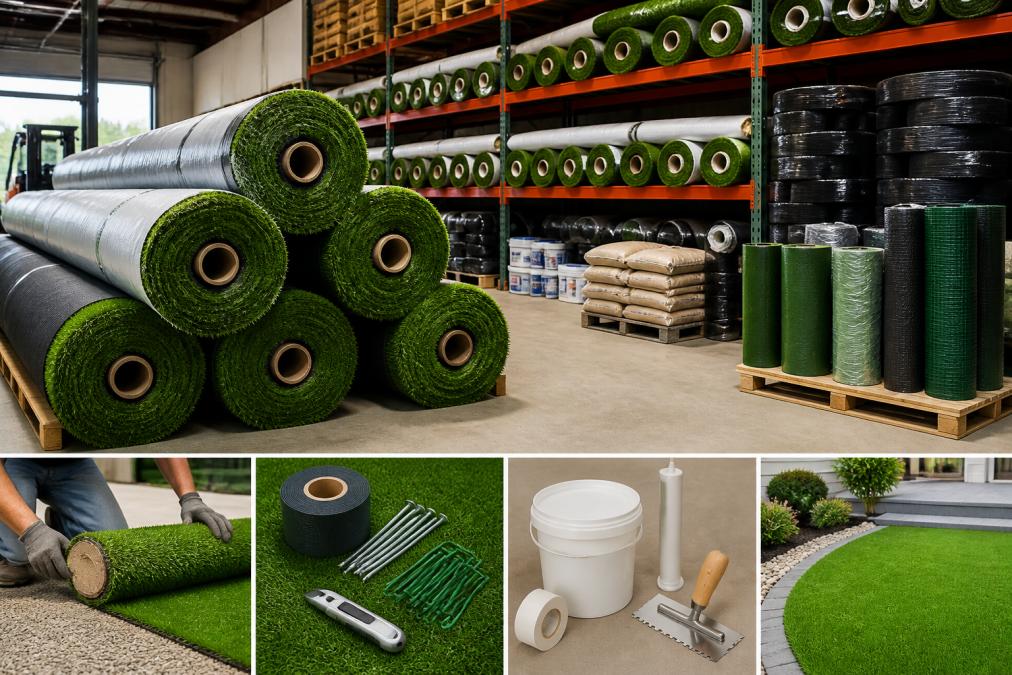
At Soco Turf Supply, we stock turf, installation materials, and equipment under one roof, so a contractor is not chasing three vendors to finish one pad. Our materials are consistent and dependable, and we back that with warehouse-direct pricing and expert guidance on every project.
Conclusion: Matching Turf Specs to How You Actually Use the Pad
The right turf for an RV pad is not the softest or the greenest product on the shelf. It is the one whose face weight, backing, and drainage match the load you are putting on it and the soil underneath it. That calculation looks different on caliche than it does on sand, and it looks different for a single rig than for a park full of them.
Soco Turf Supply supplies UV-tested, performance-rated turf, installation materials, and equipment rentals to contractors and property owners across the Permian Basin, with warehouse-direct pricing and expert guidance on every project. Get an estimate from Soco Turf Supply and build a pad that holds up to the rig, the sun, and the soil.
Frequently Asked Questions
Is artificial grass durable enough for RV parking?
Yes, when the turf is rated for vehicle traffic. The key is a short pile height (around 1 inch or less), a high face weight, and a dense backing that resists compression. Turf built for foot traffic alone will flatten under a 15,000-pound motorhome. Check that the manufacturer rates the product for vehicle loads, not just pets and playgrounds, before you commit.
Does artificial turf melt under RV tires in the Texas heat?
Heat damage comes from two sources: UV exposure and hot tires sitting on the surface. Turf with UV-stabilized fibers and a high melting point holds up better in West Texas summers. Even so, avoid parking on turf immediately after a long highway drive. Let tires cool for 20 to 30 minutes, or place a thin barrier under each tire, to reduce the risk of flat spots and surface marks.
How do you install artificial grass for an RV parking area?
Excavate 3 to 4 inches, compact a crushed aggregate base, and screed it flat with a slight slope away from any structure. Roll out the turf, let it relax, then cut and seam it. For RV pads, use longer nails or staples on tighter spacing than a backyard job, and set the infill according to the manufacturer’s spec. For installation in Midland, TX, extra base prep is often needed because caliche drains poorly.
What are the benefits of using synthetic turf for RV sites in Midland, TX?
Synthetic turf eliminates dust, mud, and gravel tracked into your RV, and it holds up to wind and heat without needing water. For rental properties with multiple pads, it also cuts ongoing maintenance to occasional rinsing and brushing. When the turf is UV-tested and rated for heavy loads, it keeps its color and structure through years of Permian Basin sun, which matters if you are managing sites long term.