
Table of Contents
- Why Artificial Grass Drainage System Installation Matters in Midland, TX
- Materials and Artificial Grass Installation Tools You’ll Need
- Step 1: Artificial Turf Sub-Base Preparation for Proper Drainage
- Step 2: Choosing the Best Drainage Aggregate for Artificial Grass
- Step 3: Installing the Drainage System and Base Layers
- Step 4: Laying Turf, Seaming, and Infill for Water Flow
- Common Drainage Mistakes to Avoid
- Conclusion
- Frequently Asked Questions
Last Updated: October 2, 2026
Why Artificial Grass Drainage System Installation Matters in Midland, TX
Water has nowhere to go in hard, caliche-heavy soil. That single fact drives every decision in artificial grass drainage system installation around Midland, where the ground can shed a heavy rain as fast as it soaks one in. Skip the drainage layer and your new turf turns into a wading pool.
At Soco Turf Supply, we supply the turf, base materials, and equipment for these builds every week. This guide walks through the full process, step by step.
Materials and Artificial Grass Installation Tools You’ll Need
Gather everything before you break ground. A missing tool mid-job means a half-compacted base sitting overnight.
Materials:
- Weed barrier fabric
- Crushed aggregate for the drainage layer
- Sharp sand or decomposed granite for the top base
- Artificial turf, seam tape, and adhesive
- Infill (silica sand or acrylic-coated sand)
- Landscape edging or bender board
- Drainage pipe and fittings
Artificial grass installation tools:
- Plate compactor
- Wheelbarrow and shovel
- Landscape rake
- Utility knife and turf cutter
- Hand tamper
- Measuring tape, string line, and stakes
- Power broom or stiff push broom
Rent what you won’t use twice. Soco Turf Supply keeps compactors and cutters available for contractors and homeowners.
Step 1: Artificial Turf Sub-Base Preparation for Proper Drainage
Sub-base prep decides whether your artificial grass drainage works at all. Get this wrong and no amount of aggregate on top will save you.
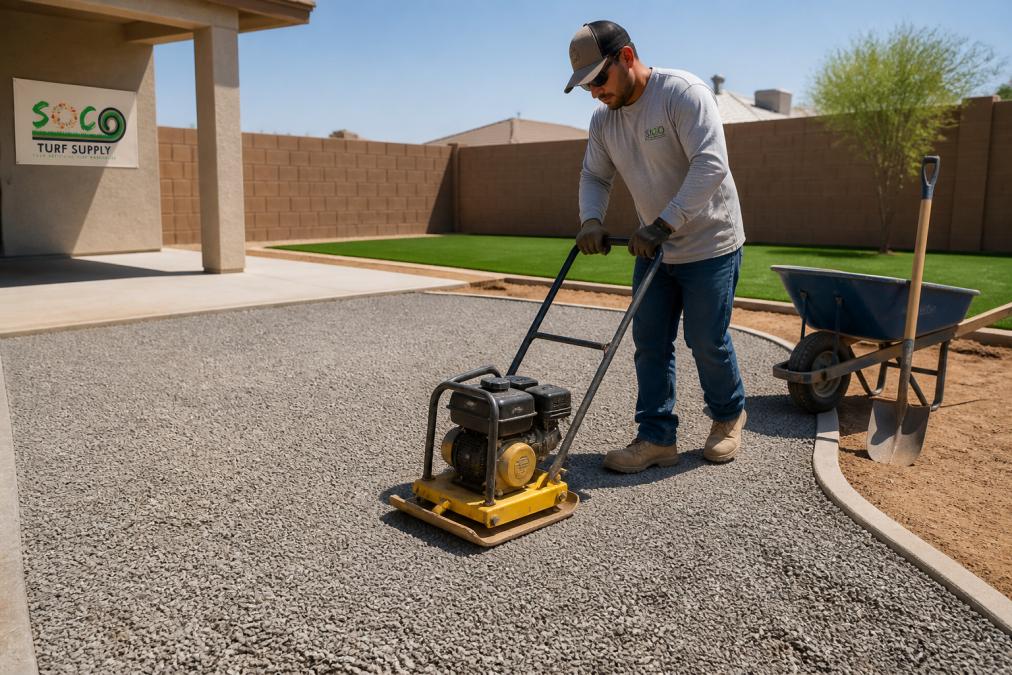
Excavation Depth and Slope for Water Flow
Dig 3 to 4 inches deep for the base layers, plus the turf and infill thickness. Then add slope. A finished grade dropping 1 to 2 inches per 10 feet pushes water toward your drain or the street.
Check slope with a string line and a level before you compact anything. Fixing grade after compaction costs twice the labor.
Compaction and Grading the Base
Compact in 2-inch lifts, not one thick pass. Each lift gets watered lightly and run over until the plate compactor stops leaving tracks.
A common mistake is skipping the edges. Soft spots at the perimeter show up as dips within a season. Run the compactor along every edge twice.
Step 2: Choosing the Best Drainage Aggregate for Artificial Grass
The best drainage aggregate for artificial grass is washed, angular crushed stone in the 3/4-inch range, laid 2 to 3 inches deep. Washed stone matters because fines clog the gaps that let water pass.
Aggregate Options That Handle West Texas Soil
Caliche and clay soils drain poorly, so aggregate choice carries more weight here than in sandy regions.
- Washed 3/4-inch crushed stone: Best all-around drainage, stable under compaction
- Crushed granite: Angular, locks together well, widely available
- Pea gravel: Drains fast but shifts underfoot; use only in shallow layers
- Decomposed granite: Good for the top base layer, not the drainage layer
Avoid anything labeled “fill dirt” or “road base” with heavy fines. It compacts into a near-solid surface.
Bagged “drainage rock” from big-box stores often contains fines that seal up once wet. Buy washed aggregate in bulk from a supplier who can tell you the sieve size.
Step 3: Installing the Drainage System and Base Layers
Build from the bottom up and don’t rush the order. Each layer depends on the one below it.
- Lay weed barrier fabric over the excavated, sloped soil.
- Install drainage pipe at the low point, running to daylight or a dry well.
- Spread 2 to 3 inches of washed aggregate over the fabric.
- Compact in lifts until the surface is firm and even.
- Add 1 to 1.5 inches of sharp sand or decomposed granite as the top base.
- Water and compact the final layer to a smooth, hard finish.
Test before turf goes down. Soak the base with a hose and watch where water pools. Any standing water means the slope or aggregate needs fixing now.
Step 4: Laying Turf, Seaming, and Infill for Water Flow
Roll the turf out and let it relax in the sun before cutting. It needs time to flatten and lose its memory from the roll.
Trim with a utility knife, leaving a small gap at seams for tape. Glue seams with turf adhesive, then press them flat. Power broom the whole surface to lift the pile.
Spread infill at roughly 1 to 2 pounds per square foot, then broom it in. Infill holds the blades upright and lets water pass between them. Too little infill means matted turf and slower drainage.
| Step | Task | Time Estimate |
|---|---|---|
| 1 | Excavate and slope sub-base | 4-6 hours |
| 2 | Compact and grade base | 2-3 hours |
| 3 | Install drainage and aggregate | 3-4 hours |
| 4 | Lay turf, seam, and infill | 4-6 hours |
Broom infill in two directions, not one. It settles more evenly and keeps blades from leaning after the first rain.
Common Drainage Mistakes to Avoid
Most failures trace back to a handful of shortcuts. Here are the ones we see most.
- Skipping the slope. Flat bases hold water. Always grade toward a drain point.
- Using unwashed aggregate. Fines turn your drainage layer into a seal.
- Compacting in one thick lift. The bottom stays loose and settles later.
- No weed barrier. Weeds push through and tear the base apart over time.
- Too little infill. Blades mat down and water slows to a crawl.
- Poor seam work. Open seams let water lift the edges.
Each of these costs more to fix than to prevent. Do it right the first time.
Conclusion
A drainage system that fails means torn-up turf, re-excavated base, and a second round of labor. Midland’s soil and heat leave no margin for shortcuts. Soco Turf Supply supplies UV-tested turf, washed aggregate, and the compactors and cutters to get sub-base prep right the first time. Contractors across the Permian Basin rely on our warehouse-direct materials for consistent, dependable results. Get an estimate from Soco Turf Supply and build a base that drains for good.
Frequently Asked Questions
Does artificial grass need a drainage system in Midland, TX?
Yes. Midland sits on heavy clay soil that absorbs water slowly, so rain and irrigation can pool under turf without a drainage layer. Most installations use a compacted aggregate base plus a perforated drain or French drain to move water away. Skipping this step in West Texas soil leads to standing water, shifting turf, and long-term damage to the base.
How do you install a sub-base for artificial turf drainage?
Excavate 3 to 4 inches deep, compact the native soil, then add 2 to 3 inches of crushed aggregate in lifts. Compact each lift, grade a 1 to 2 percent slope toward your drain or exit point, and keep the surface smooth. Proper artificial turf sub-base preparation is the single biggest factor in how well the finished lawn drains.
What materials are best for artificial grass drainage in West Texas soil?
Crushed granite, washed angular gravel, and 3/4-inch crushed rock are common choices because they lock together under compaction and let water pass through. Avoid rounded river rock, which shifts and holds less structure. The best drainage aggregate for artificial grass is angular, washed, and free of fines that clog water flow.
Can poor drainage cause artificial turf to smell?
Yes, especially in pet areas. When water and waste sit under the turf because the base does not drain, bacteria build up and produce odors. A properly compacted aggregate base, correct slope, and perforated drainage pipe keep liquids moving through instead of pooling. Occasional rinsing and a suitable infill also help control smells.