Table of Contents
- Why Turf Durability Standards Exist for Commercial Sites
- The Core Metrics Behind Commercial Artificial Turf Durability Standards
- Synthetic Turf Wear and Tear Testing: How Labs Measure Longevity
- UV Resistance Ratings for Synthetic Turf in West Texas Sun
- Artificial Grass Drainage Capacity Standards for Heavy-Use Sites
- How Midland, TX Conditions Stress Turf Durability
- How to Verify Durability Claims Before You Buy
- Frequently Asked Questions
Last Updated: October 13, 2026
Why Turf Durability Standards Exist for Commercial Sites
Commercial artificial turf durability standards exist because a surface that carries thousands of footsteps, vehicles, and hours of direct sun has to be specified, not guessed at. At Soco Turf Supply, we see the difference constantly: two rolls can look identical in a showroom and behave nothing alike after a year on a Midland, TX parking island or pet relief area.
Residential turf is judged on appearance. Commercial turf is judged on what it does after 10,000 footfalls and a West Texas summer. That gap is why the industry developed measurable criteria: face weight, tuft bind, UV stability, and drainage rate. Each one predicts a specific failure mode.
Below, we break down the metrics that matter, how labs test them, and how to verify a supplier’s claims before you commit a commercial budget.
The Core Metrics Behind Commercial Artificial Turf Durability Standards
The core metrics behind commercial artificial turf durability standards are face weight, pile height, backing construction, tuft bind, UV stability, and drainage rate. Together they describe how a turf system resists crushing, fiber loss, fading, and standing water under repeated commercial loads.
No single number tells the whole story. A heavy face weight on a weak backing still sheds fibers. A strong backing with poor drainage still turns a heavy-use site into a mud pit. Specifiers evaluate the metrics as a system.
Face Weight, Pile Height, and What They Signal
Face weight is the mass of fiber per square yard, and it is the first number to check on a commercial spec sheet. Higher face weight generally means denser fiber and better resistance to crushing under foot traffic, though it only delivers that benefit when paired with an appropriate pile height.
Pile height controls how the surface behaves under load. Short pile resists matting and is easier to clean, which suits walkways, pet areas, and hard-use commercial zones. Taller pile looks plusher but compresses faster where traffic concentrates.
The pairing matters more than either figure alone. A low pile with a substantial face weight holds up under constant footfall; a tall pile with a light face weight is the combination that flattens first.
Backing Systems and Tuft Bind
Tuft bind measures the force required to pull a single fiber tuft out of the backing, and it is the metric that separates turf that stays put from turf that sheds. Commercial installations need higher tuft bind than residential because foot traffic, cleaning equipment, and pet activity all work fibers loose.
Backing systems come in several constructions, and each trades off differently:
- Single-layer backing: lightest and least expensive, best suited to light residential use
- Dual-layer backing: adds dimensional stability, a reasonable middle ground for moderate traffic
- Triple-layer or composite backing: highest dimensional stability, the usual choice for commercial and heavy-use sites
- Perforated backing: punched with holes to move water through the surface quickly
A common mistake is specifying a premium face fiber and then accepting a light backing to hit a budget. The backing is where commercial turf fails first.
Synthetic Turf Wear and Tear Testing: How Labs Measure Longevity
Synthetic turf wear and tear testing measures longevity by simulating years of traffic in weeks. Labs run turf samples through mechanical abrasion, repeated loading, and accelerated weathering, then measure how much the fiber, backing, and pile structure have degraded.
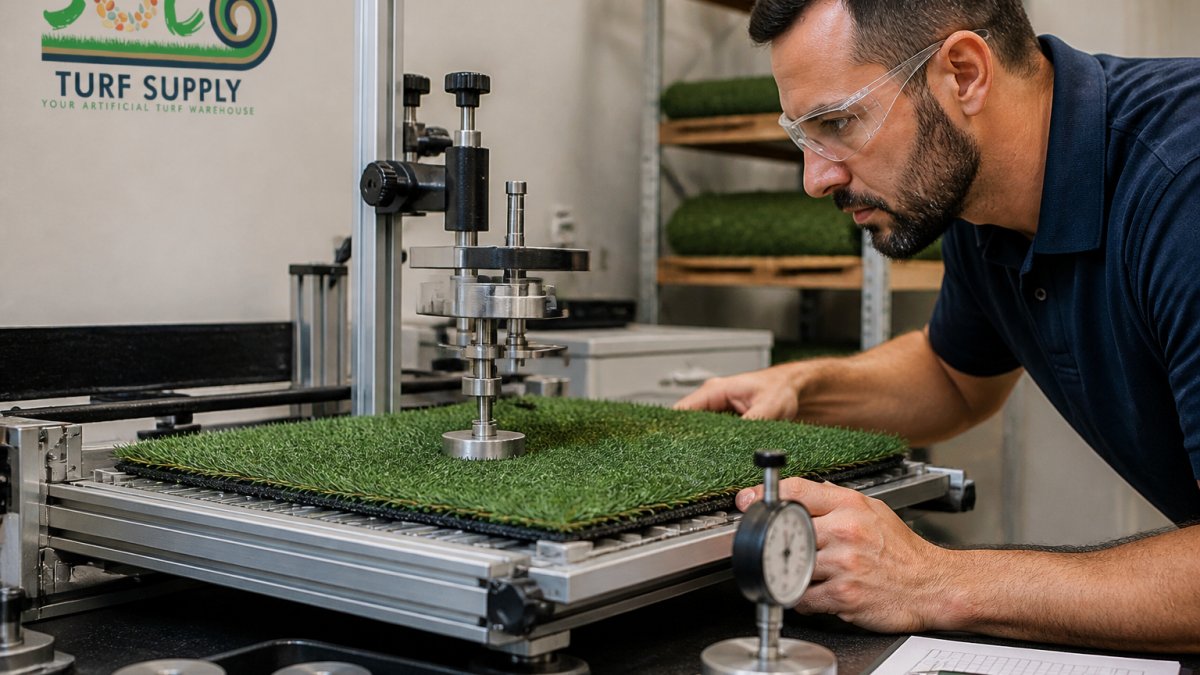
The main test categories are:
- Abrasion resistance: a mechanical drum or wheel cycles over the sample to simulate foot traffic and equipment wear, and the lab records fiber loss and surface change
- Tuft bind pull testing: a device grips individual tufts and measures the force needed to extract them, before and after simulated wear
- Compression and recovery: the sample is loaded repeatedly, then measured to see how much pile height it recovers
- Accelerated weathering: the sample sits in a chamber that concentrates UV exposure, heat, and moisture to approximate years of sun in a compressed window
What most buyers miss is that these tests produce relative results, not absolute promises. A lab report tells you how one construction performed against another under identical conditions.
Ask for the test method, not just the result. A tuft bind figure without a stated method is a marketing number.
UV Resistance Ratings for Synthetic Turf in West Texas Sun
UV resistance ratings for synthetic turf describe how well the fiber and backing hold their color and tensile strength after prolonged ultraviolet exposure. In West Texas, that rating is not a nice-to-have; it is the difference between turf that still looks uniform after several summers and turf that chalks, fades, and turns brittle.
Ultraviolet radiation breaks down polymer chains in the fiber over time. Manufacturers counter this with UV stabilizers compounded into the fiber and with colorants chosen for lightfastness. The quality and loading of those stabilizers, not the color of the turf, determine how it weathers.
When you evaluate a UV claim, look for:
- A stated test standard rather than a vague “UV treated” label
- Whether the test covered the fiber, the backing, or the full system
- Colorfastness results measured after weathering, not before
- Documentation you can pass to a client or property owner
Artificial Grass Drainage Capacity Standards for Heavy-Use Sites
Artificial grass drainage capacity standards define how fast water moves through the turf surface and the base beneath it. On heavy-use commercial sites, drainage is the metric that decides whether the surface stays usable after a storm or becomes a saturated, smelly problem area.
Water has to travel through three layers: the turf backing, the infill if present, and the compacted base below. A restriction at any layer backs water up regardless of how well the others perform. Perforated backings move water through the surface quickly; the base then has to carry it away.
For commercial and pet-heavy installations, drainage design usually includes:
- A perforated or heavily drained backing
- A graded aggregate base sized for the expected water volume
- Slope built into the subgrade so water has somewhere to go
- A plan for the peak load, not the average rainfall
Odor complaints in pet areas almost always trace back to drainage and cleaning, not to the turf fiber itself. When waste and water sit in the base, no fiber specification will fix it. This is where installation materials and guidance matter as much as the turf roll.
How Midland, TX Conditions Stress Turf Durability
Midland, TX conditions stress turf durability in ways a coastal or temperate climate does not. Intense solar exposure, low humidity, wide day-to-night temperature swings, and alkaline soils all act on a turf system simultaneously, and each one attacks a different part of the specification.
The sun drives UV degradation and heat buildup on the surface. Low humidity means the turf dries quickly after rain, which helps, but it also means the fiber has no natural moisture buffering.
Alkaline soil chemistry matters at the base layer. It influences how aggregate and subgrade materials behave over time, which is one reason a generic installation spec from a wetter climate does not transfer cleanly to the Permian Basin.
For property managers running multiple sites around Midland, the practical takeaway is that durability has to be specified for this climate, not for a national average.
How to Verify Durability Claims Before You Buy
Verifying durability claims before you buy comes down to documentation. A credible supplier can produce test reports, state the standards behind them, and explain how the specification matches your site’s traffic and climate. A supplier who cannot is asking you to take their word for it.
Use this checklist before you commit:
- Request the face weight and pile height in writing, with the unit of measure stated
- Ask for tuft bind results and the test method used to produce them
- Confirm the backing construction and whether it is perforated
- Request UV weathering documentation, including the test standard and colorfastness results
- Ask for the drainage rate of the turf system and the base specification that supports it
- Confirm the specification accounts for your traffic level, not a residential default
- Get the warranty terms in writing, including what voids coverage
- Ask whether installation materials and guidance come from the same supplier as the turf
|
What to Verify |
What to Ask For |
Why It Matters |
|---|---|---|
|
Face weight |
Written figure with unit |
Predicts resistance to crushing |
|
Tuft bind |
Result plus test method |
Predicts fiber shedding |
|
Backing type |
Construction and perforation |
Predicts dimensional stability |
|
UV performance |
Standard and colorfastness data |
Predicts fading and brittleness |
|
Drainage |
System rate and base spec |
Predicts standing water and odor |
|
Warranty |
Terms and exclusions |
Defines your recourse |
Soco Turf Supply stocks UV-tested, performance-rated turf and the installation materials that go with it, with warehouse-direct pricing and guidance built from construction experience. If you need documentation you can hand to a client, we can walk you through the specification.
Specifying commercial turf for a heavy-use site means matching the fiber, backing, and base to real traffic and real climate, and then proving it with documentation. That is harder than it sounds, and it is where most projects go wrong.
Soco Turf Supply supplies UV-tested, performance-rated turf, professional installation materials, and equipment rentals with warehouse-direct pricing and expert guidance on every project. Whether you are managing one property or several across the Permian Basin, our team can help you specify a system that holds up. Get an estimate from Soco Turf Supply and start your project with materials you can stand behind.
Frequently Asked Questions
What are the industry standards for commercial artificial turf durability?
Commercial turf durability is typically measured through face weight, tuft bind strength, UV resistance ratings, and drainage capacity. ASTM International publishes several test methods, including ASTM D5841 for tuft bind and ASTM D1335 for pile yarn pull. Buyers should request documentation showing tested performance against these standards rather than relying on marketing claims alone.
How does the West Texas climate affect artificial turf longevity?
West Texas combines intense UV exposure, high summer temperatures, and periodic heavy rainfall. UV radiation breaks down synthetic fibers over time, causing fading and brittleness. Heat accelerates wear on lower-quality backings. Turf with strong UV stabilizers and proper drainage handles these conditions better, but no product lasts forever without maintenance.
What UV-testing metrics should I look for in commercial turf?
Look for UV resistance ratings expressed in hours of accelerated weathering, often tested per ASTM D4329 or similar methods. Higher hour ratings indicate greater resistance to fading and fiber degradation. Also check whether the manufacturer provides documentation of colorfastness and tensile strength retention after UV exposure, since these directly affect how long the turf stays usable.
How do I determine the face weight and pile height for high-traffic commercial areas?
High-traffic commercial areas generally need higher face weights, often 60 ounces per square yard or more, and moderate pile heights that resist matting. Pile height between 1.25 and 2 inches works for most commercial applications. The right combination depends on expected foot traffic, equipment loads, and whether the area sees vehicle use.
What are the maintenance requirements for commercial-grade synthetic turf?
Commercial turf needs regular brushing to prevent matting, periodic infill replenishment, and prompt removal of debris. High-traffic zones may need more frequent attention. Drainage systems should be inspected seasonally to prevent clogs. Following a maintenance schedule extends the life of any installation, regardless of initial quality.
Why is drainage capacity a critical durability factor for commercial installations?
Standing water degrades backing materials, promotes mold and bacterial growth, and creates safety hazards. Artificial grass drainage capacity standards typically call for permeability rates of at least 30 inches of water per hour. Poor drainage leads to premature failure of seams and backing layers, shortening the turf’s usable life significantly.