Last Updated: October 28, 2026
Quick Summary
Industrial landscaping maintenance runs on a written checklist that logs every inspection, cleaning task, and repair by frequency and crew initials. Schedule grooming by site traffic zones rather than the calendar, and split work roughly 80 percent machine and 20 percent hand tools.
- Walk the perimeter first, then work inward, noting the location of each issue.
- Log the date, crew initials, tasks completed, and anything flagged for repair.
- Assign each traffic zone to a named crew member and post the schedule in the shop.
- Water and cool the surface during extreme heat spells and groom in cooler morning hours.
- Blow down hard surfaces and curbs first, then the turf, so grit stays out of the pile.
Table of Contents
- Start With an Industrial Turf Maintenance Checklist
- Build a Commercial Turf Maintenance Schedule Around Site Traffic
- Pick the Right Artificial Turf Maintenance Equipment for Large Sites
- Artificial Turf Maintenance Best Practices for Hot, Dry Sites
- Control Dust and Debris Before It Reaches the Infill
- Fix Drainage and Odor Problems Before They Spread
- Order Turf, Materials, and Rentals in One Warehouse-Direct Stop
- Frequently Asked Questions
Start With an Industrial Turf Maintenance Checklist
Industrial landscaping maintenance tips only pay off when the crew works from a written industrial landscaping checklist instead of memory. A checklist can help crews keep track of maintenance tasks.
An industrial turf maintenance checklist is a written record of every inspection, cleaning task, and repair performed on a synthetic surface, organized by frequency and signed off by the crew member who did the work. It turns vague upkeep into a repeatable routine any crew member can follow.
What Belongs on a Weekly Walkthrough
Walk the perimeter first, then work inward. Look for lifted seams, wrinkled panels, standing water after irrigation, compacted infill along high-traffic lanes, and debris caught against fences and curbs. Note the location of each issue, not just the problem.
- Seam edges and perimeter fasteners
- Drainage grates and channel drains clear of debris
- Infill depth on walkways and entry points
- Standing water or soft spots
- Trash, glass, and organic debris
What to Log After Every Visit
Log the date, crew initials, tasks completed, and anything flagged for repair. Two lines per visit is enough. The log becomes your early-warning system: three straight weeks of “infill low at gate 4” tells you to order material before the backing wears.
Build a Commercial Turf Maintenance Schedule Around Site Traffic
Traffic, not the calendar, should set your commercial turf maintenance schedule. Schedule by zone.
| Zone | Traffic Level | Grooming Frequency | Infill Check |
|---|---|---|---|
| Entry points and walkways | Heavy | Weekly | Weekly |
| Loading and staging areas | Heavy | Weekly | Weekly |
| Common seating and gathering areas | Medium | Every 2 weeks | Monthly |
| Perimeter and decorative borders | Light | Monthly | Quarterly |
Map the site into these zones on paper, post the schedule in the shop, and assign each zone to a named crew member. When traffic patterns change, such as a new tenant or a rerouted delivery lane, redraw the map.
Pick the Right Artificial Turf Maintenance Equipment for Large Sites
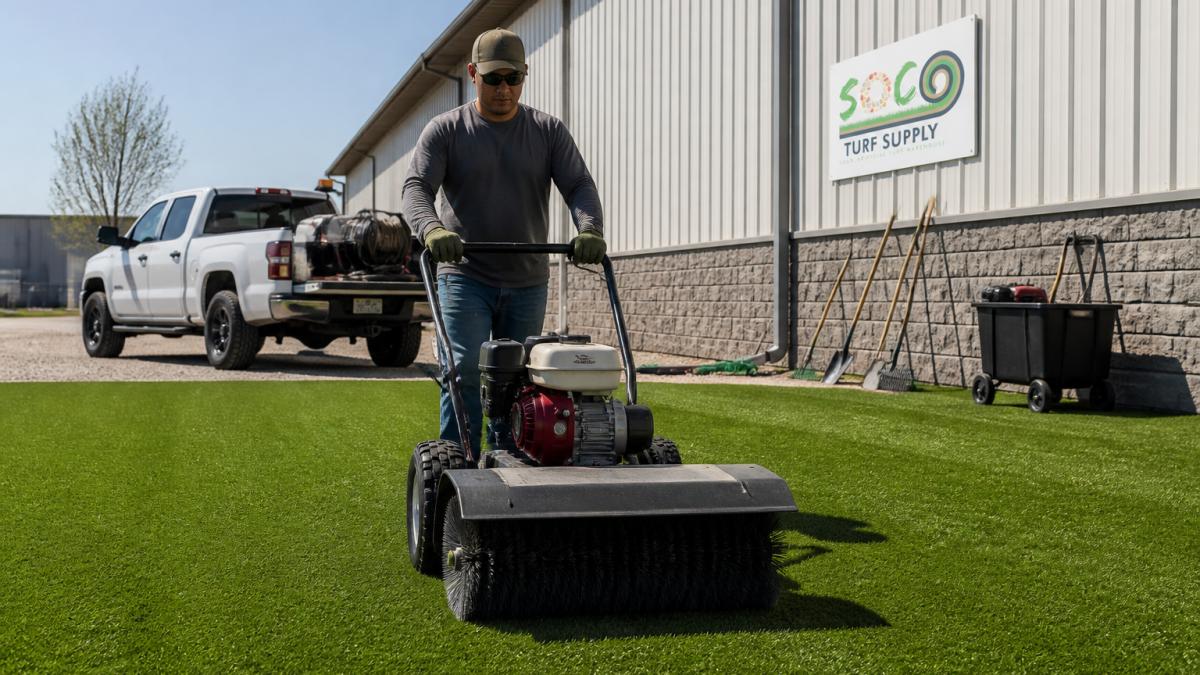
Large sites punish the wrong tool choices. A crew pushing hand brooms across large areas may take longer than using a motorized unit.
For high-traffic commercial surfaces, review artificial turf for high foot traffic so equipment and material specs match the load. If your crew needs power equipment without buying it outright, professional turf installation equipment rental covers the tools large sites require.
Power Equipment vs. Hand Tools: Where Each Earns Its Keep
Power equipment wins on open, high-traffic areas: motorized sweepers, blowers, and infill spreaders cover ground fast and keep infill evenly distributed. Hand tools win on edges, corners, seams, and around fixtures, where machines cannot reach without risking damage. A practical split is roughly 80 percent machine work on open panels and 20 percent hand work on detail zones. Watch out: running a stiff power broom too aggressively on low-pile turf can pull infill and fray fibers, so match brush stiffness to pile height.
Artificial Turf Maintenance Best Practices for Hot, Dry Sites
Heat is the maintenance variable crews underestimate. In prolonged sun and dry air, surface temperatures climb well above air temperature, and fibers take more UV load. The practical response is simple: water and cool the surface during extreme heat spells, keep infill topped up because it shields the backing, and schedule heavy grooming for cooler morning hours.
For sites dealing with sustained heat, preventing artificial turf heat damage in Midland TX goes deeper on shade planning, cooling routines, and fiber care. A common mistake is skipping irrigation checks because the surface is synthetic; drainage and base moisture still matter.
Control Dust and Debris Before It Reaches the Infill
Dust control starts before the debris reaches the infill. Blow down hard surfaces and curbs first, then the turf, so you are not pushing grit back into the pile. Use leaf blowers at moderate power, and bag organic debris rather than blowing it into corners.
Infill choice does much of the work here. An infill selected for drainage and stability holds its place better under wind and washdown, which keeps dust down and fibers upright. Review best turf infill for drainage before committing to a blend for a dusty industrial site.
Fix Drainage and Odor Problems Before They Spread
Drainage problems announce themselves early: soft spots, standing water hours after rain, and a musty smell near pet or food-service areas. Address them the week you notice them, because water trapped under backing degrades the base and turns a small fix into a panel replacement.
Clear grates and channel drains first, then check that infill has not migrated into drainage paths. Persistent odor usually traces to trapped moisture and organic matter, not the turf itself. Where drainage needs rework, artificial grass drainage system installation explains how proper base and drainage layers are built so water moves instead of pooling.
Order Turf, Materials, and Rentals in One Warehouse-Direct Stop
The tips above only hold if materials arrive when the schedule says they should. Running out of infill mid-season, or waiting on a rental unit while a seam sits open, breaks the routine you built.
That is where we come in. Soco Turf Supply offers UV-tested, performance-rated turf blends, installation materials, and equipment rentals, with warehouse-direct pricing and no middleman. Our materials are consistent and dependable.
Get started with Soco Turf Supply.
Frequently Asked Questions
How often should commercial turf be maintained?
Set the schedule by traffic zone, not the calendar. Groom and check infill weekly on heavy-traffic areas like entries, walkways and loading zones. Groom every two weeks and check infill monthly in medium-traffic seating areas. Light-traffic perimeters and borders need grooming monthly and an infill check quarterly. Walk the whole site once a week and log what you find.
What maintenance does artificial turf need at an industrial site?
Start with a weekly walkthrough: check seam edges and perimeter fasteners, clear drainage grates and channel drains, measure infill depth at walkways and entry points, and look for standing water, soft spots and debris. Then groom to keep fibers upright, top up infill in high-traffic lanes, and fix drainage problems the week you spot them. After every visit, log the date, crew initials, work done, and anything flagged for repair.
What equipment is useful for maintaining large commercial turf areas?
Use motorized sweepers, blowers and infill spreaders on open, high-traffic panels. Use hand brooms and rakes on edges, corners, seams and around fixtures. A good rule of thumb is about 80% machine work and 20% hand work. Match brush stiffness to pile height, because a stiff power broom can pull infill and fray low-pile turf. If you’d rather not buy equipment outright, Soco Turf Supply offers equipment rentals.
How should turf maintenance change during hot, dry weather in Midland, TX?
Do heavy grooming in the cooler morning hours. Rinse and cool the surface during extreme heat spells, and keep infill topped up, since it shields the backing from heat and UV. Keep checking irrigation and drainage too: base moisture and drainage still matter under synthetic turf in West Texas heat.
