Last Updated: October 28, 2026
Quick Summary
Cost effective landscaping for oil sites is possible when you choose a durable surface measured by total cost of ownership rather than sticker price. Artificial turf for commercial properties cuts recurring labor, water, and replacement cycles, so you spend once on a surface that holds instead of paying for it every month.
- Bare soil erodes and loose gravel migrates, so surfaces needing weekly attention cost more than they save.
- Judge artificial turf by total cost of ownership, not the upfront number alone.
- Installation should deliver a flat, drained, seam-tight surface that resists rutting from foot and vehicle traffic.
- Ask for verifiable UV testing and performance ratings in writing, not marketing language.
- Monthly dusting, brushing high-traffic lanes, seam checks, drainage clearing, and spill spot-cleaning keep costs flat.
Table of Contents
- Why Oil Site Landscaping Bleeds Money Without the Right Surface
- Artificial Turf for Commercial Properties: The Cost Math That Matters
- Commercial Artificial Turf Installation: Step-by-Step for Industrial Sites
- Artificial Turf for High-Traffic Areas: Specs That Survive Trucks and Boots
- Industrial Landscaping Maintenance: The Short List That Keeps Costs Flat
- Get an Estimate for Your Midland Site
- Frequently Asked Questions
Why Oil Site Landscaping Bleeds Money Without the Right Surface
Cost effective landscaping for oil sites starts with one hard truth: every square foot of ground cover on a lease road, pad edge, or equipment yard is either working for you or quietly draining your maintenance budget.
The problem is not effort. It is surface choice. Ground that gets walked, driven, and baked all summer needs a surface that tolerates all three without constant intervention. Bare soil erodes. Loose gravel migrates. Anything that demands weekly attention on a site you visit monthly will cost more than it saves.
Below, we break down where the money actually goes, what a durable surface looks like, and how to spec one that survives a West Texas work site.
Artificial Turf for Commercial Properties: The Cost Math That Matters
Artificial turf for commercial properties is a surfacing decision measured in total cost of ownership, not sticker price. The upfront number is only the first line of the ledger. The lines that follow, covering maintenance labor, water, replacement cycles, and downtime, decide whether the surface pays for itself.
What Drives the Upfront Number
If you want to see how middleman markup inflates that upfront number, our guide on avoiding middleman turf markup explains what warehouse-direct buying actually changes.
Where the Savings Come From Over Time
The math compounds. Every season you avoid re-grading and dust control is a season of budget returned to production work. That is the case for cost effective landscaping for oil sites: spend once on a surface that holds, then stop paying for it every month.
Commercial Artificial Turf Installation: Step-by-Step for Industrial Sites
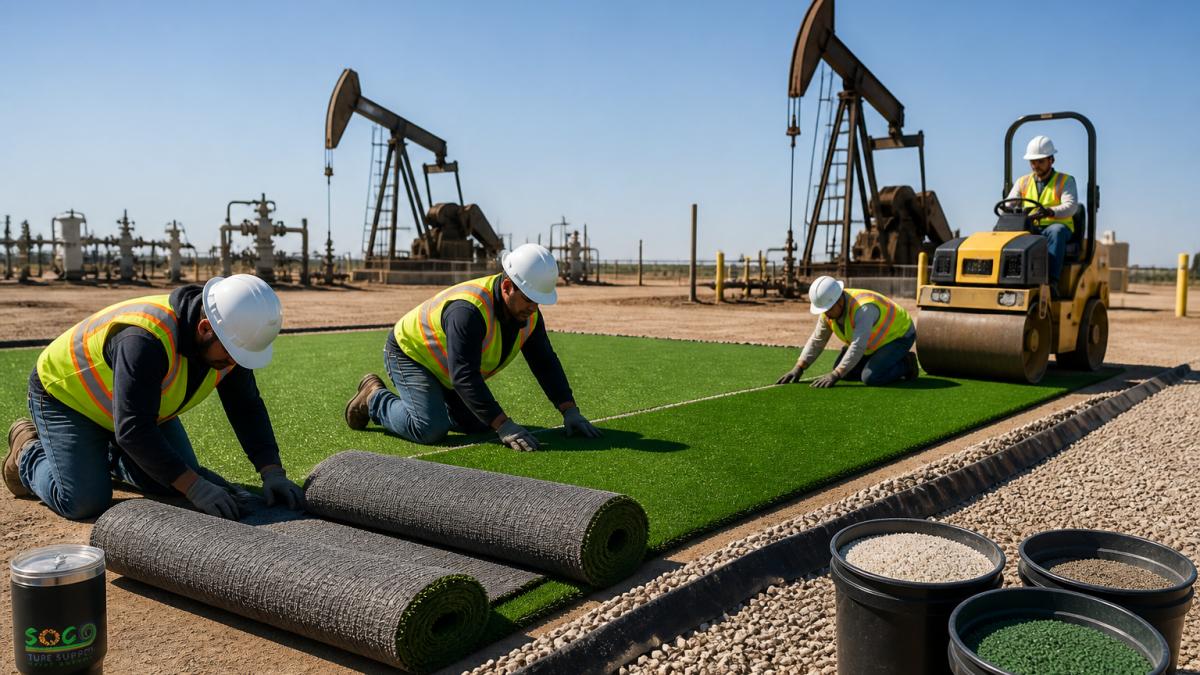
Expected Result: A flat, drained, seam-tight surface that holds up to foot and vehicle traffic without rutting.
Artificial Turf for High-Traffic Areas: Specs That Survive Trucks and Boots
Ask for documentation, not marketing language. UV testing and performance ratings should be verifiable in writing, which matters when you answer to a client or a corporate asset team. Our artificial turf for high-traffic areas page shows the specs built for heavy foot and vehicle use, and the commercial artificial turf durability standards page covers what to require in writing.
Industrial Landscaping Maintenance: The Short List That Keeps Costs Flat
Industrial landscaping maintenance on a turf surface is a short, predictable list. That predictability is the point: a surface with a fixed maintenance routine is a surface you can budget for.
- Blow or rinse off dust and debris monthly
- Brush fibers upright in high-traffic lanes
- Check seams and edges after heavy equipment moves
- Clear drainage paths before storm season
- Spot-clean spills before they set
That is the whole routine. Compare it to the seasonal cycle of re-grading, dust suppression, and replacement that loose surfaces demand, and the labor savings become obvious. For a deeper maintenance checklist, read our industrial landscaping maintenance tips that help crews cut time on site.
The maintenance routine on a turf surface is short and predictable, which is what makes it budgetable.
| Task | Frequency or timing |
|---|---|
| Blow or rinse off dust and debris | Monthly |
| Brush fibers upright in high-traffic lanes | As part of routine |
| Check seams and edges | After heavy equipment moves |
| Clear drainage paths | Before storm season |
| Spot-clean spills | Before they set |
Get an Estimate for Your Midland Site
Our warehouse-direct model cuts the middleman out of the supply chain, and our UV-tested, performance-rated turf blends provide consistency and durability for professional-grade outdoor installations. Contractors trust us, and customers describe our materials as consistent and dependable.
Get started with Soco Turf Supply and request an estimate for your site, with a specification built around how your ground actually gets used.
Frequently Asked Questions
What landscaping works best for oil sites in Midland, TX?
Surfaces that need almost no water or upkeep perform best: artificial turf over a properly compacted aggregate base, plus gravel or crushed stone for equipment lanes. Midland’s heat, caliche soil, and dust mean anything requiring irrigation or mowing costs more each year. Turf rated for UV exposure and heavy foot traffic holds its color and pile height through summer, and it can be cleaned of dust and spills with a blower or hose rather than a maintenance crew.
How can oil-site landscaping reduce ongoing maintenance?
Most of the savings come from removing recurring tasks: no mowing, no irrigation repairs, no re-seeding after a washout. A turf surface needs periodic brushing, rinsing, and infill top-ups, which one person can handle on a quarterly schedule. Pair that with a base built for drainage and you avoid the ponding and mud that turn a gravel pad into a re-grading job every spring. Fewer trips by a crew means fewer invoices.
What should contractors consider when choosing artificial turf for an industrial site?
Check face weight, backing strength, and UV testing documentation before anything else. Ask for performance data you can hand a client, not marketing language. Confirm the turf handles vehicle traffic at access points, and plan the base depth for your soil conditions. Drainage design matters more on industrial pads than on backyards because runoff volume is higher. Finally, confirm your supplier can restock the same blend later, so a repair patch matches the original.
How do you plan landscaping around vehicle and equipment access?
Map the turning radii and parking lanes first, then choose surfaces by load. Keep turf out of direct truck paths and use compacted aggregate or turf with a reinforced backing where vehicles cross. Set bollards or edge restraints to keep tires off the turf edge, since edge failure is the most common repair on industrial sites. Leave clear sight lines at gates and corners, and route drainage away from equipment pads so standing water does not undermine the base.
The challenge is simple: most oil site surfaces are chosen by default, not by design. Change that, and the maintenance budget follows. Soco Turf Supply supplies warehouse-direct turf, installation materials, and equipment rentals, with expert guidance on every project and UV-tested, performance-rated blends built for industrial duty. Get started with Soco Turf Supply and put a surface in place that stops costing you every month.
