Table of Contents
- Why High Foot Traffic Breaks Down Cheap Turf
- Comparing Artificial Turf Types for High Foot Traffic
- Artificial Turf Pile Height: Finding the Sweet Spot for Busy Areas
- Artificial Grass Face Weight and What It Says About Durability
- Artificial Turf Backing: The Layer That Decides Drainage and Longevity
- Artificial Turf Maintenance for Heavy-Use Installations
- Choosing the Right Turf for Midland Yards and Commercial Sites
- Conclusion
- Frequently Asked Questions
Last Updated: October 19, 2026
Why High Foot Traffic Breaks Down Cheap Turf
Artificial turf for high foot traffic fails at the fiber level long before it looks worn out. Cheap products use short, loosely tufted fibers and a thin backing, so the surface mats down, the pile flattens, and the seams start to lift within a couple of seasons of real use. At Soco Turf Supply, we see the same pattern in Midland, TX: a low-cost roll that looked fine on day one turns shiny and compacted on the paths people actually walk. The fix is not a premium brand name. It is spec discipline. Below, we break down the four numbers that separate turf built for daily use from turf built for a photo. For context on how synthetic surfaces are manufactured and rated, the Synthetic Turf Council’s guidance library is a useful starting point.
Comparing Artificial Turf Types for High Foot Traffic
Three categories cover nearly every heavy-use project: short-pile landscape turf, mid-pile performance turf, and sports-style turf with a tall pile. Short-pile landscape turf is the workhorse for walkways, patios, and pet areas. Mid-pile performance turf handles mixed residential and light commercial traffic. Tall sports-style turf looks the most like a lawn but demands more grooming under constant use.
How the Main Turf Categories Stack Up
| Turf Type | Pile Height | Face Weight | Best For | Main Trade-Off |
|---|---|---|---|---|
| Short-pile landscape | 25-35 mm | 40-60 oz | Walkways, pet runs, patios | Firmer underfoot |
| Mid-pile performance | 35-45 mm | 60-80 oz | Busy yards, commercial entries | Higher material cost |
| Sports-style tall pile | 45-60 mm | 80+ oz | Lawns with light traffic | Mats down without grooming |
Short-pile landscape turf wins on durability per dollar. Less fiber means less to crush, and the dense stitch holds its shape under repeated footfalls.
Mid-pile performance turf is our default recommendation for high foot traffic. It balances a realistic look with enough face weight to survive daily use.
Sports-style tall pile is the wrong pick for a busy entrance. The extra height looks great in photos and flattens fastest where people walk.
Artificial Turf Pile Height: Finding the Sweet Spot for Busy Areas
Pile height is the length of the fiber measured from the backing to the tip. For high foot traffic, 30-40 mm is the sweet spot: tall enough to look natural, short enough that boots and paws cannot flatten it into a mat. Anything under 25 mm reads as a putting green; anything over 45 mm needs brushing to stay upright. If you are comparing rolls on a supplier’s spec sheet, check pile height first, because it sets the ceiling on everything else.
Ask for the pile height in millimeters and the face weight in ounces on the same spec sheet. A tall pile with a light face weight is the worst combination for busy areas: it looks lush and crushes fast.
Artificial Grass Face Weight and What It Says About Durability
Face weight is the mass of fiber per square yard, and it is the closest thing turf has to a durability rating. Heavier face weight means more fiber packed into each stitch, which resists matting and holds color longer under sun and shoes. For high foot traffic, aim for 60 oz and up. Lighter products in the 40 oz range suit decorative edges and low-use corners, not the path from the driveway to the front door.
Artificial Turf Backing: The Layer That Decides Drainage and Longevity
Backing is the layer under the fibers, and it does two jobs: it holds the tufts in place and it decides how fast water leaves the surface. A weak backing lets tufts pull out and traps water, which is how pet areas end up smelling. Perforated and drainage-rated backings move water through instead of ponding it on top.
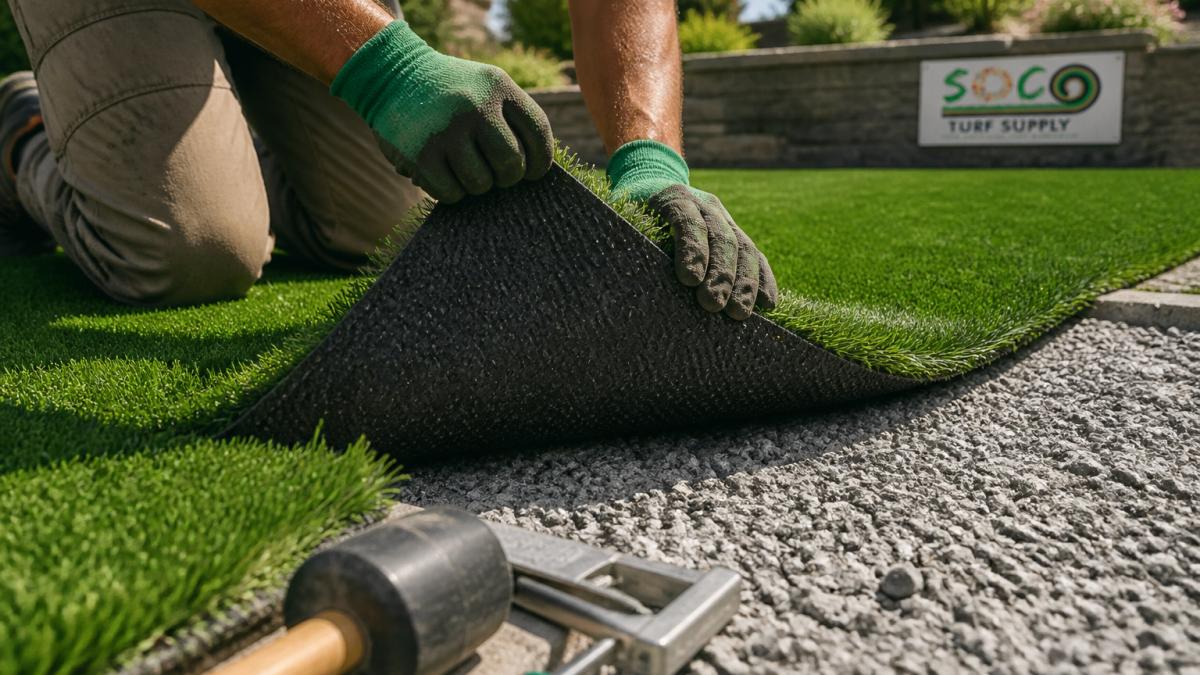
For heavy-use installations, we specify a backing with a secondary coating and visible perforations, plus a compacted aggregate base underneath. The base matters as much as the roll. Poor base prep is the most common reason a good product fails, and it is the part most online buyers never see.
Skipping base compaction to save a day of labor is the mistake that returns a year later. Water pools at the low spots, the backing stays wet, and seams lift first. Fix the base before the turf goes down, not after.
Artificial Turf Maintenance for Heavy-Use Installations
Maintenance on a busy surface is about three habits: brush, rinse, and inspect. Brush the pile against the grain every few weeks to lift crushed fibers. Rinse pet areas regularly and check that water drains instead of pooling. Inspect seams and edges twice a year, because a lifted seam spreads fast under foot traffic.
- Brush high-traffic lanes against the grain every 2-4 weeks
- Rinse pet zones weekly and confirm drainage
- Sweep debris before it works into the pile
- Check seams and perimeter edges each season
- Reapply infill in worn lanes as needed
The EPA’s guidance on permeable surfaces and stormwater is a helpful reference if drainage performance is part of your site plan.
Choosing the Right Turf for Midland Yards and Commercial Sites
Midland heat is hard on synthetic surfaces, so UV-tested, performance-rated turf is not optional here. Ask for documentation you can hand to a client, not just a marketing line. For a commercial site with steady foot traffic, spec mid-pile performance turf with 60-80 oz face weight and a drainage-rated backing. For a rental property or a busy backyard, short-pile landscape turf in the 40-60 oz range is the practical pick. If you are searching for artificial turf near me in Midland, buy from a supplier who can walk the spec sheet with you and supply the base materials and equipment in the same order.
For high foot traffic, match pile height (30-40 mm) to face weight (60 oz and up) to a drainage-rated backing. Get all three right and the turf holds up. Miss one and the surface fails early.
Conclusion
Specifying turf for heavy use comes down to reading four numbers and refusing to guess. If you want a supplier who will match the roll, the base materials, and the equipment to your project, Soco Turf Supply offers warehouse-direct pricing, UV-tested and performance-rated turf blends, and expert guidance on every order. Contractors across the Permian Basin rely on our materials because they are consistent and dependable. Get an estimate from Soco Turf Supply and spec the right turf the first time.
Frequently Asked Questions
What type of artificial turf is best for high foot traffic?
Turf built for high foot traffic typically combines a moderate pile height (around 1 to 1.5 inches), a higher face weight, and a durable backing with good drainage. Short, dense fibers resist matting better than long, soft blades, which flatten under repeated steps. Ask for UV-tested, performance-rated products and documentation showing how the turf performed under wear testing, not just marketing claims.
What turf pile height works best for high-traffic areas?
For busy yards, commercial entries, and pet areas, pile height in the 1 to 1.5 inch range usually holds up best. Shorter fibers stay upright under repeated footfall and are easier to clean. Taller, plusher turf feels softer underfoot but mats faster in walkways and doorways. Match the pile height to the use: shorter for paths and heavy zones, slightly taller for low-traffic lounging areas.
Does artificial turf flatten in high-traffic areas?
It can, especially lower-density turf with long fibers. Flattening happens when fibers lack the density and backing support to spring back after repeated weight. Choosing a higher face weight, a shorter pile, and a stable backing reduces matting. Regular artificial turf maintenance, including brushing and rinsing, also helps fibers recover and keeps the surface looking even in busy spots.
Is artificial turf suitable for dogs and high foot traffic?
Yes, when the turf is specified for it. Look for a backing that drains quickly, a face weight suited to heavy use, and fibers that resist wear from claws. Proper installation matters as much as the product: a well-compacted base and correct infill keep the surface stable. Rinsing pet areas regularly and brushing high-traffic zones keeps odors down and fibers upright.