Last Updated: November 2, 2026
Quick Summary
For most Midland homeowners, artificial turf is worth the investment when the upfront cost is weighed against years of water savings, near-zero maintenance, and a lawn that survives West Texas heat without constant care. The honest answer depends on three variables: how much lawn you’re replacing, what you currently spend on water and lawn care, and how long you plan to stay.
- Build a year-by-year break-even model using upfront cost, annual water spend, lawn-care spend, and expected lifespan.
- Water rates trending upward in Midland pull your break-even point earlier.
- Ask for quotes broken into turf material, base and excavation, drainage and grading, and labor and infill.
- A low per-square-foot quote can reflect a thinner aggregate base, causing pooling, wrinkles, and odor later.
- Include end-of-life removal and disposal cost in your model from day one, not as a year-fifteen surprise.
Table of Contents
- Is Artificial Turf Worth the Investment in 2026?
- Artificial Turf Cost Calculator: What Drives the Upfront Number
- Benefits of Artificial Turf in Desert Climates
- Water Savings and Utility-Bill Impact in West Texas
- Maintenance, Durability, and the Long-Term Cost Picture
- Heat Retention, Pet Use, and Environmental Trade-Offs
- Pros and Cons: Artificial Turf vs. Natural Grass
- Getting a Turf Estimate for Your Midland Project
- Frequently Asked Questions
Is Artificial Turf Worth the Investment in 2026?
For most Midland homeowners, artificial turf is worth the investment when the upfront cost is weighed against years of water savings, near-zero maintenance, and a lawn that survives West Texas heat without constant care. Water rates and drought cycles have been tightening, which changes the math. This guide breaks down the real numbers, the trade-offs, and the break-even model so you can decide with facts instead of sales pitches.
The honest answer depends on three variables: how much lawn you’re replacing, what you currently spend on water and lawn care, and how long you plan to stay. Get those right and the decision becomes clear.
Artificial Turf Cost Calculator: What Drives the Upfront Number
Artificial turf cost isn’t a single figure. It’s a stack of line items, and each one moves the total. The biggest drivers are square footage, turf grade, base preparation, and drainage work, and the spread between a low quote and a high quote on the same yard is usually explained by what’s buried under the turf, not the turf itself.
Here’s what actually determines your quote:
- Square footage: The dominant variable. Every additional area adds turf, infill, and labor, and most suppliers price in tiers, so a 1,500 sq ft project often lands at a lower per-square-foot rate than a 400 sq ft patch.
- Turf grade and pile height: Performance-rated blends with higher face weights and UV stabilization cost more than thin utility rolls. Face weight (ounces per square yard) and backing construction are the two specs that most reliably separate grades.
- Base preparation: Excavation, compaction, and a proper aggregate base are non-negotiable for drainage. Base preparation is one of the line items that most affects how long an installation lasts.
- Drainage and grading: Sloped sites and poor soil require more prep work, and caliche-heavy West Texas soil can slow excavation and change how much base material a site needs.
- Access and haul-off: Tight side yards, gate widths, and old material removal add labor. A backyard with no alley access can add meaningful labor hours versus a front yard a truck can reach.
- Cutting, seaming, and infill: Detail work that separates a clean install from a patchy one. Seam placement, edge restraint, and infill selection are where workmanship shows up years later.
Pricing depends on quantity, site conditions, and delivery. For current prices or a quote, visit the Soco Turf Supply website before you request quotes.
| Cost Driver | What It Affects | Why It Matters |
|---|---|---|
| Square footage | Total material and labor | Largest single variable; tiered pricing rewards larger jobs |
| Turf grade | Durability, UV resistance | Cheap turf fades and mats faster |
| Base preparation | Drainage, stability | Skipping it causes failures and premature replacement |
| Drainage work | Water runoff, pooling | Prevents soggy patches and pet odors |
| Site access | Labor hours | Tight spaces and haul-off cost more |
| Seaming and infill | Appearance, longevity | Poor seams lift and fray within a few seasons |
How to read a quote. Ask for the quote broken into four buckets: turf material, base and excavation, drainage and grading, and labor and infill. If a bidder can’t separate those, you can’t compare bids fairly, and you can’t tell whether the low number is a better deal or a thinner base. When comparing quotes, the prep line items are often where the real difference sits.
Watch out: a low per-square-foot quote can reflect a thinner aggregate base. Base decisions often show up later as pooling, wrinkles, and odor, and fixing them can cost more than the original savings.
Benefits of Artificial Turf in Desert Climates
In desert climates, artificial turf delivers its clearest wins: it stays green year-round, needs no irrigation to survive, and holds up through heat and drought cycles that punish natural grass. That’s the core case for a lawn replacement in West Texas.
The benefits stack up quickly:
- No watering schedule. Turf doesn’t wilt when restrictions hit.
- No mowing, edging, or fertilizer. Weekend time comes back to you.
- No bare patches. High-traffic zones stay intact.
- Consistent curb appeal. A green lawn in a dry season stands out.
For a deeper look at what performs in extreme heat, our guide to long-lasting turf for desert climates covers heat resistance, infill choices, and maintenance for Midland yards.
Water Savings and Utility-Bill Impact in West Texas
Water savings are the strongest financial argument for turf in West Texas, and they compound every month as rates rise and drought restrictions tighten. Natural grass is thirsty; a well-installed synthetic lawn draws no irrigation water at all.
The catch is that savings depend on what you were spending before. A large, heavily watered lawn produces bigger savings than a small, low-use patch. To estimate your own number, pull a year of water bills and isolate outdoor use. That figure, multiplied across the turf’s lifespan, is your savings pool.
Local drought conditions and watering restrictions make this more than a budgeting exercise. When restrictions cap outdoor watering, natural grass browns while turf stays green. That reliability has real value in a market where water conservation is a growing priority.
Maintenance, Durability, and the Long-Term Cost Picture
Artificial turf’s long-term cost picture is where it wins or loses. The upfront number is high; the recurring number is low. Over a decade, that flips the comparison, but only if you actually run the years instead of trusting the headline.
Ongoing costs are modest but not zero:
- Occasional rinsing and debris removal, especially after West Texas dust storms
- Brushing to keep infill evenly distributed and pile upright
- Spot cleaning for spills and pet waste
- Occasional top-off of infill in high-traffic zones
Durability and lifespan depend on product quality and installation. Turf that is UV-tested and performance-rated and installed over a proper base is designed for long service; poor prep can shorten its life and bring an unplanned replacement cost. Warranty terms vary by manufacturer, read whether the warranty covers labor, fading, and seam failure, or only the material itself, because a material-only warranty still leaves you paying for removal and reinstall.
A year-by-year break-even model you can adjust. Rather than a single payback number, build the comparison year by year. The model has four inputs: your upfront turf cost, your current annual outdoor water spend, your current annual lawn-care spend (mowing, trimming, fertilizer, and any repair), and your expected turf lifespan before replacement. Each year, add the water and lawn-care savings to a running total and compare it to the upfront cost. The year the running total crosses the upfront cost is your break-even.
Where the model breaks. The break-even math assumes you actually would have spent that water and lawn-care money. If you’re already on a low-water landscape or you mow your own small lawn, the savings pool is smaller and payback stretches out. It also assumes the turf is installed well enough to reach its rated lifespan, a failed base resets the clock and the model with it.
Watch out: replacement cost is the line most homeowners leave out. Even a long-lived product has an end-of-life removal and disposal cost, and if you plan to stay in the home past the turf’s rated life, that number belongs in the model from day one, not as a surprise in year fifteen.
Heat Retention, Pet Use, and Environmental Trade-Offs
Artificial turf does run hotter than natural grass under direct West Texas sun, and that’s the honest downside every buyer should weigh. Surface temperature climbs on exposed turf, so shade, infill choice, and timing of use matter.
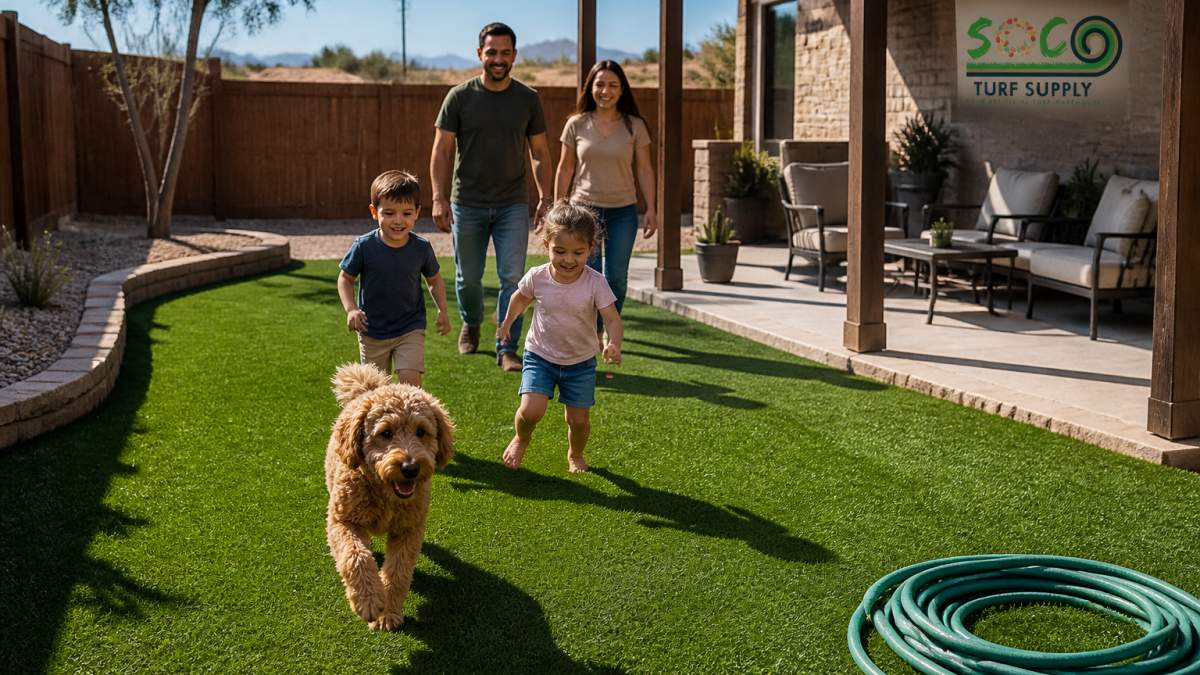
For pet owners, pet turf and odor control are the top concerns. Proper drainage and infill designed for pets make cleanup manageable; poor installation is where odors and pooling start. If heat is your worry, our guide to preventing artificial turf heat damage in Midland covers cooling strategies. And if you have dogs, our roundup of the best artificial turf for dogs shortlists pet-friendly options built to hold up.
Environmental trade-offs cut both ways: you trade water consumption and lawn chemicals for a manufactured product with an end-of-life disposal question. Neither side is free.
Pros and Cons: Artificial Turf vs. Natural Grass
Artificial turf wins on water, maintenance, and consistency; natural grass wins on upfront cost and heat. The right choice depends on which column matters more to you.
| Factor | Artificial Turf | Natural Grass |
|---|---|---|
| Upfront cost | Higher | Lower |
| Water use | None for irrigation | High, ongoing |
| Maintenance | Low | Mowing, feeding, watering |
| Heat | Runs hotter in sun | Cooler underfoot |
| Durability | Holds up to traffic | Wears in high-traffic zones |
| Year-round look | Consistent green | Browns in drought |
Pros of turf: predictable costs, no mowing, drought-proof appearance, strong curb appeal.
Cons of turf: higher upfront spend, heat retention, disposal at end of life.
Watch out: the most common failure we see is skipping base preparation to save money. Poor drainage leads to pooling, odors, and premature replacement, which erases the savings you were counting on.
Getting a Turf Estimate for Your Midland Project
A turf estimate for your Midland project should be itemized, not a single lump figure. Ask for turf grade, base prep, drainage, infill, and labor broken out separately so you can compare quotes fairly.
Timing matters too. Scheduling installation in cooler months avoids working over hot surfaces and lets the material settle before peak summer. For commercial and multi-site projects, confirm your supplier’s inventory and delivery reliability up front.
At Soco Turf Supply, we provide warehouse-direct pricing with no middleman, UV-tested and performance-rated turf blends, and the installation materials and equipment rentals a project needs. One customer describes the materials as consistent and dependable. When you’re ready to move from math to a real number, get an estimate for your project.
Frequently Asked Questions
How much does it cost to install 1000 square feet of artificial grass?
Installation pricing depends on turf grade, base preparation, drainage work, and site access, so no single figure fits every yard. Request itemized quotes from Soco Turf Supply so you can compare material and labor separately rather than a single bundled number.
Does artificial turf increase property value in Midland?
Curb appeal and year-round appearance can help a home show better, and buyers in the Permian Basin often value low-water landscaping. Whether it raises appraised value depends on the appraiser, the neighborhood, and installation quality. Poor drainage or visible seams can hurt rather than help, so document the turf’s UV testing and warranty and keep installation records for resale.
How does the West Texas climate impact the lifespan of artificial turf?
Intense UV, heat, and dust are the main stressors. Quality turf with UV-tested fibers and a stable backing is designed to resist fading and brittleness better than budget products. Proper base preparation and drainage matter just as much, since poor drainage leads to wrinkles and premature failure. Ask for performance documentation rather than relying on marketing claims.
Is artificial turf a durable solution for high-traffic areas?
Performance-rated turf blends are designed for repeated foot traffic, pets, and commercial use. Durability depends on fiber height, face weight, backing strength, and correct infill. For larger commercial or multi-site projects, confirm the manufacturer’s traffic rating and warranty terms before ordering, and plan for periodic brushing and infill top-ups.
The real question isn’t whether artificial turf costs more upfront, it’s whether your water bills and weekend hours are worth more than that upfront number over the next decade. For most Midland homeowners, they are. Soco Turf Supply offers warehouse-direct pricing, UV-tested performance-rated turf, and expert guidance on every project, whether you’re a homeowner or managing multiple sites. Get started with Soco Turf Supply and turn a thirsty lawn into a low-maintenance asset.
