Table of Contents
- Why Artificial Turf for Dogs Beats a Muddy Yard
- Key Features That Define the Best Artificial Turf for Dogs
- Infill Options and Why They Matter for Pet Turf
- Artificial Grass Drainage Systems: How Permeability Prevents Puddles
- Antimicrobial Artificial Turf and Odor Control Technology
- How to Clean Dog Urine From Artificial Turf
- DIY vs. Professional Installation: What Pet Owners Should Know
- Conclusion
- Frequently Asked Questions
Last Updated: September 27, 2026
Why Artificial Turf for Dogs Beats a Muddy Yard
The best artificial turf for dogs solves a problem that real grass cannot: it stays clean, drains fast, and survives heavy paw traffic without turning into a mud pit. At Soco Turf Supply, we hear the same complaint from pet owners every week, and it usually involves a back door, four wet paws, and a floor that needs mopping again.
Real grass wears down along fence lines and potty routes. Bare patches appear within months. After rain, those patches become mud, and mud travels indoors. Artificial turf for dogs eliminates that cycle because the surface never thins out, never turns to sludge, and never needs a recovery period.
There is a catch, though. Not every synthetic product is built for animals. The wrong turf holds odor, traps heat, and matts down under repeated use. The right one handles all three. Below, we break down the features that separate pet-grade turf from standard landscape turf, plus how to clean it, what infill actually does, and whether you should install it yourself.
Key Features That Define the Best Artificial Turf for Dogs
The best artificial turf for dogs combines three measurable specs: pile height, face weight, and tuft bind. Get these right and the surface holds up for years. Get them wrong and you will replace it within two seasons.
Learn how to fix backyard drainage problems with practical solutions for standing water, poor grading, French drains, and West Texas yards.
Pile Height, Face Weight, and Tuft Bind
Pile height is the length of the grass blades measured from the backing. For dog areas, a range of roughly 1.25 to 1.75 inches works well. Taller blades feel softer under paws but flatten faster. Shorter blades stay upright but offer less cushion.
Face weight measures how much fiber sits in a square yard, and it is the single best predictor of durability. Pet turf generally starts around 60 ounces per square yard and climbs from there. Higher face weight means denser blades, better resilience, and less visible wear in high-traffic zones like a pet run.
Tuft bind is the force required to pull a blade out of the backing. Weak tuft bind means shedding fibers and bald spots.
| Feature | What It Measures | Target Range for Dogs | Why It Matters |
|---|---|---|---|
| Pile height | Blade length | 1.25-1.75 inches | Balance of softness and resilience |
| Face weight | Fiber per square yard | 60+ ounces | Durability under heavy traffic |
| Tuft bind | Blade anchoring strength | High pull resistance | Prevents shedding and bald spots |
| Backing | Base fabric type | Perforated, multi-layer | Drainage and stability |
UV Resistance and Heat Dissipation for Desert Climates
Heat is the feature most buyers overlook, and in the Permian Basin it matters more than almost anything else. Standard polyethylene turf can absorb sunlight and reach surface temperatures that are uncomfortable for bare paws.
Cheap turf without UV stabilization breaks down fast in intense sun. Blades fade, fibers crack, and the surface turns scratchy within a season or two. Ask for UV test documentation before you buy.
Infill Options and Why They Matter for Pet Turf
Infill is the material spread between the blades, and it is the most important choice for odor control. Infill holds the blades upright, adds weight to the surface, and gives urine somewhere to go besides the backing.
Artificial Grass Drainage Systems: How Permeability Prevents Puddles
Artificial grass drainage systems work by moving liquid through the turf backing, into a drainage grid, and down into a prepared sub-base. When every layer performs, urine and wash water disappear within minutes.
- Perforated backing: lets liquid pass through the turf layer
- Drainage grid: channels water laterally toward exits
- Graded sub-base: slopes the ground so water flows away
- Crushed aggregate layer: stores and filters water before it drains
Antimicrobial Artificial Turf and Odor Control Technology
Antimicrobial artificial turf uses treated fibers and infill to slow bacterial growth that causes persistent odor. Bacteria, not urine alone, produce the ammonia smell that lingers in pet areas.
How to Clean Dog Urine From Artificial Turf
To clean dog urine from artificial turf, dilute the spot with water, apply a pet-safe enzyme cleaner, rinse thoroughly, and let the area drain. Fast action prevents odor from settling into the infill.
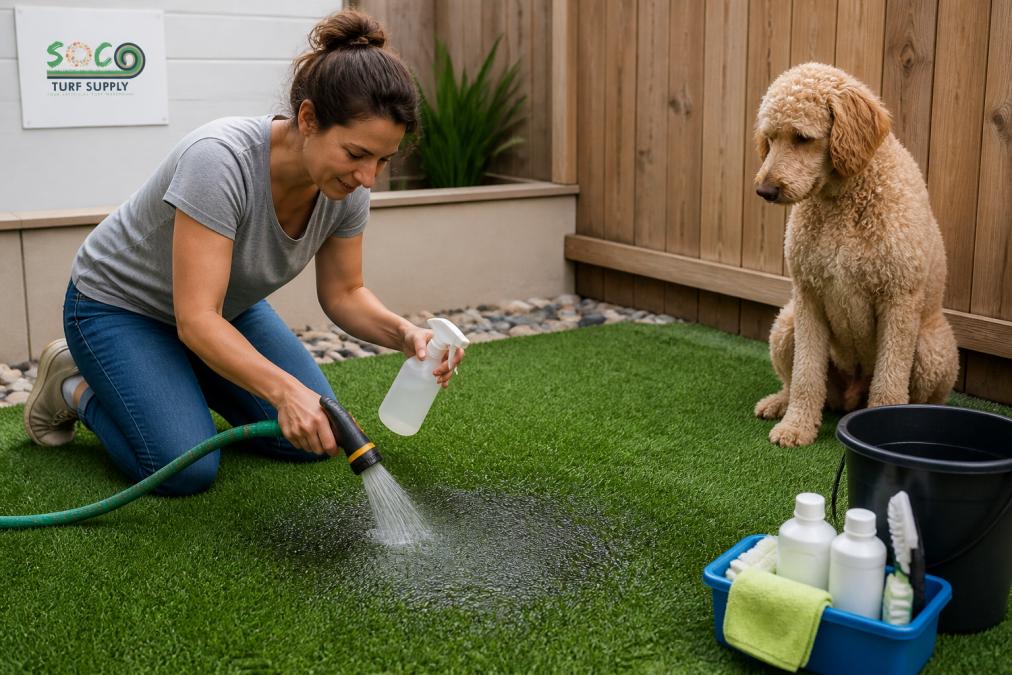
Follow this routine for solid results:
- Pick up solids immediately. Use a bag and remove waste before it breaks down.
- Flush the area with water. A hose on low pressure pushes urine through the backing.
- Apply an enzyme-based cleaner. These break down uric acid that plain water leaves behind.
- Rinse again. Clear residue so the cleaner does not sit in the infill.
- Sanitize weekly in heavy-use zones. A diluted pet-safe sanitizer handles bacterial growth.
- Brush the blades. A stiff brush lifts matted fibers and redistributes infill.
A simple maintenance schedule keeps the surface in shape:
| Frequency | Task | Purpose |
|---|---|---|
| Daily | Remove solid waste | Prevents breakdown and staining |
| Weekly | Rinse potty zones | Flushes urine from infill |
| Monthly | Enzyme treatment | Breaks down uric acid residue |
| Seasonally | Brush and top off infill | Restores blade lift and coverage |
Rinse potty areas in the morning rather than the evening. The surface dries faster during the day, and bacteria have less time in a warm, damp environment.
DIY vs. Professional Installation: What Pet Owners Should Know
DIY installation can work for small, flat yards with good existing soil. Professional installation makes more sense for large areas, poor drainage, or commercial properties where downtime is costly. The honest answer is that the decision hinges on the sub-base, not the turf, and most guides skip that part because they are trying to sell you a roll of product.
The Real Trade-Off: Sub-Base Work
Laying turf is the easy part. Preparing a graded, compacted base that drains correctly is the hard part, and it is where most DIY projects fail. A pet run installed over ungraded ground will puddle, smell, and shift within a year. That failure is not a product defect, it is a base defect, and it is expensive to fix after the fact because the turf has to come back up.
A Simple Decision Framework
Use these questions to sort your project before you commit to either path:
- How big is the area? Small, contained pet runs are far more forgiving of DIY than large open yards, because there is less base to grade and less surface to keep flat.
- Does water already pool there after rain? If yes, the drainage problem exists before the turf does, and it will not fix itself under a synthetic surface.
- How flat and stable is the existing ground? Slopes, tree-root heaves, and soft spots all demand base work that is hard to do well without equipment.
- How much time do you actually have? Base prep is the slow part. If you are squeezing it into a weekend, you will rush the step that determines whether the install lasts.
- Is this a commercial or high-traffic site? Downtime and liability push these toward professional installation almost every time.
What DIY Saves and What It Costs You
DIY saves on labor, and that is the main line item. What it does not save is the risk: if the base is wrong, you pay twice, once for materials and once to redo the work. For a small residential yard, a careful DIY install with proper base preparation can hold up well. For anything over a few hundred square feet, or any surface with drainage problems, bring in help.
Where Each Path Wins
| Situation | Better Fit | Why |
|---|---|---|
| Small, flat, well-draining pet run | DIY | Low base complexity, manageable area |
| Large yard or multiple zones | Professional | Grading and compaction scale with area |
| Existing drainage problems | Professional | Base correction is the whole job |
| Tight timeline | Professional | Crews compress the slow base-prep stage |
| Commercial or high-traffic site | Professional | Downtime, liability, and wear tolerance |
Soco Turf Supply works with both groups. We stock turf, infill, and installation materials, and our team walks contractors and homeowners through the specs that matter for pet areas. If you are weighing a DIY build against a professional install, our guidance on sub-base prep and drainage is where most projects get saved.
Conclusion
Choosing turf for a dog area comes down to drainage, infill, and durability, not color or brand marketing. Get the sub-base right, pick a turf with real face weight and tuft bind, and stay consistent with cleaning.
Frequently Asked Questions
Is it okay for dogs to pee and poop on fake grass?
Yes, dogs can safely use artificial turf for potty breaks as long as the product is non-toxic and installed with proper drainage. Urine passes through perforated backing and a drainage grid into the sub-base, while solid waste is picked up just like on a natural lawn. Choose turf with antimicrobial protection and rinse the area regularly to prevent ammonia buildup and bacterial growth.
Which turf is best for dogs that can tolerate urine?
Look for artificial turf for dogs with high permeability, a drainage rate above 30 inches per hour, and antimicrobial-infused backing. Polyethylene blades with a pile height around 1.25 to 1.5 inches and a face weight of 60 to 80 ounces offer a balance of softness, resilience, and urine drainage. Turf with UV resistance also holds up better under heavy sun exposure and heavy traffic.
How do I stop my fake grass from smelling of dog urine?
Rinse the area with water within a few hours of each potty break, then use a pet-safe enzymatic cleaner once a week to break down ammonia. Antimicrobial artificial turf slows bacterial growth in the thatch layer, but it does not replace regular cleaning. For multi-dog households, a monthly deeper sanitization and occasional top-dressing of infill keeps odor reduction consistent.
Does artificial turf get too hot for dog paws?
Surface temperature depends on blade color, infill, and sun exposure. Lighter-colored blades and infill with heat dissipation properties stay cooler than dark rubber. In desert climates, hose the turf down before letting dogs out during peak afternoon hours, and test the surface with your palm for five seconds. If it is too hot for your hand, it is too hot for paws.