Table of Contents
- Why Artificial Turf Fits Housing Projects in the Permian Basin
- Artificial Turf Specifications for Contractors
- Artificial Turf Project Planning Checklist
- Artificial Turf for Apartment Complexes
- Installation Process for Housing Projects
- Artificial Turf Maintenance for Commercial Properties
- Sourcing Artificial Turf in Midland, TX
- Conclusion
- Frequently Asked Questions
Last Updated: October 5, 2026
Why Artificial Turf Fits Housing Projects in the Permian Basin
Housing developers across the Permian Basin face a simple math problem: water costs keep climbing, and traditional lawns keep dying. That is why artificial turf for housing projects has moved from a novelty to a standard line item on many new builds in Midland, TX and the surrounding region.
At Soco Turf Supply, we work with builders, property managers, and developers every week who need ground cover that survives 100-degree summers without irrigation. Artificial turf is a synthetic grass surface made from UV-stabilized fibers stitched into a permeable backing, designed to look and feel like natural grass without the water, mowing, or mud.
The case for turf on housing projects comes down to three things:
- No irrigation lines, sprinkler repair, or water bills
- No mowing crews, fertilizer, or seasonal rework
- Consistent appearance across dozens of units, year round
For multifamily and RV park projects, that consistency matters as much as the savings. A single failed lawn in a 40-unit complex is a maintenance ticket. Forty failed lawns is a budget problem.
U.S. Environmental Protection Agency WaterSense program notes that outdoor water use can account for a large share of residential consumption in arid regions, which is exactly the pressure driving turf adoption here.
Artificial Turf Specifications for Contractors
Contractors who buy turf on appearance alone usually regret it. The specs that matter are pile height, face weight, and backing construction, because those three numbers decide how the product performs under traffic and heat.
Pile Height, Face Weight, and Backing
Pile height is the length of the grass blade, measured in millimeters. Face weight is the amount of fiber per square yard, measured in ounces. Backing is the layer that holds the fibers and controls drainage.
Here is how the common ranges compare:
|
Specification |
Light Use |
Medium Use |
Heavy Use |
|---|---|---|---|
|
Pile height |
25-30 mm |
30-37 mm |
37-45 mm |
|
Face weight |
40-50 oz |
50-60 oz |
60-80+ oz |
|
Primary backing |
Standard poly |
Dual-layer poly |
Dual-layer with drainage holes |
|
Best for |
Balconies, patios |
Apartment courtyards |
Dog parks, common areas |
For housing projects, we generally steer contractors toward the medium-to-heavy range. Light-use turf looks fine on day one and flattens in high-traffic corridors by year two.
UV Testing and Heat Performance
West Texas sun is the hardest test a turf product will face. UV-stabilized fibers resist fading and brittleness, but the quality of that stabilization varies by manufacturer.
Ask for documentation, not marketing claims. A performance-rated product should come with test data you can hand to a client or an inspector. If a supplier cannot produce it, that tells you something.
Artificial Turf Project Planning Checklist
A good artificial turf project planning checklist prevents the two biggest cost overruns on housing jobs: ordering the wrong quantity and skimping on base depth.
Work through these before you order:
- Measure each area and add 5-10% for cuts and waste
- Confirm base depth for your soil and drainage conditions
- Check slope and identify low spots that need correction
- Verify access for equipment and material delivery
- Plan seam locations so they fall out of main sightlines
- Confirm drainage path away from foundations and walkways
- Order infill and seaming materials with the turf, not after
- Schedule installation around other trades, not after them
Estimating Quantity and Base Depth
Measure in square feet, then convert to square yards, since turf is sold by the square yard. Add waste for angled cuts and seams. On a project with lots of planters and walkways, waste runs higher than most people expect.
Base depth typically falls in the 2 to 4 inch range for most housing applications, with compacted crushed aggregate underneath. Deeper base helps in areas with poor drainage or heavy use. Shallow base is the single most common shortcut, and it shows up as wrinkles, pooling, and uneven settling within the first year.
Pricing depends on quantity, product specs, and delivery, so we quote each project individually rather than publishing a number that will not fit your job.
Artificial Turf for Apartment Complexes
Apartment complexes are where turf pays for itself fastest. Common areas, dog runs, and pool decks all take a beating that natural grass cannot survive.
Property managers tell us the same thing: mowing crews, irrigation repairs, and re-sodding eat the landscaping budget every year. Turf replaces all three with a surface that looks the same in July as it does in January.
A few things we recommend for apartment projects specifically:
- Spec heavier face weight for dog runs and main walkways
- Use a drainage-rated backing in areas that see standing water
- Plan for pet waste stations near turf zones, not across the property
- Keep a small stock of matching turf for future patch repairs
For managers running multiple sites across the basin, the bigger win is consistency. One product spec across three properties means one maintenance playbook, not three.
Installation Process for Housing Projects
Installation quality decides whether a turf project lasts five years or fifteen. The steps are straightforward, but each one has to be done in order and done right.
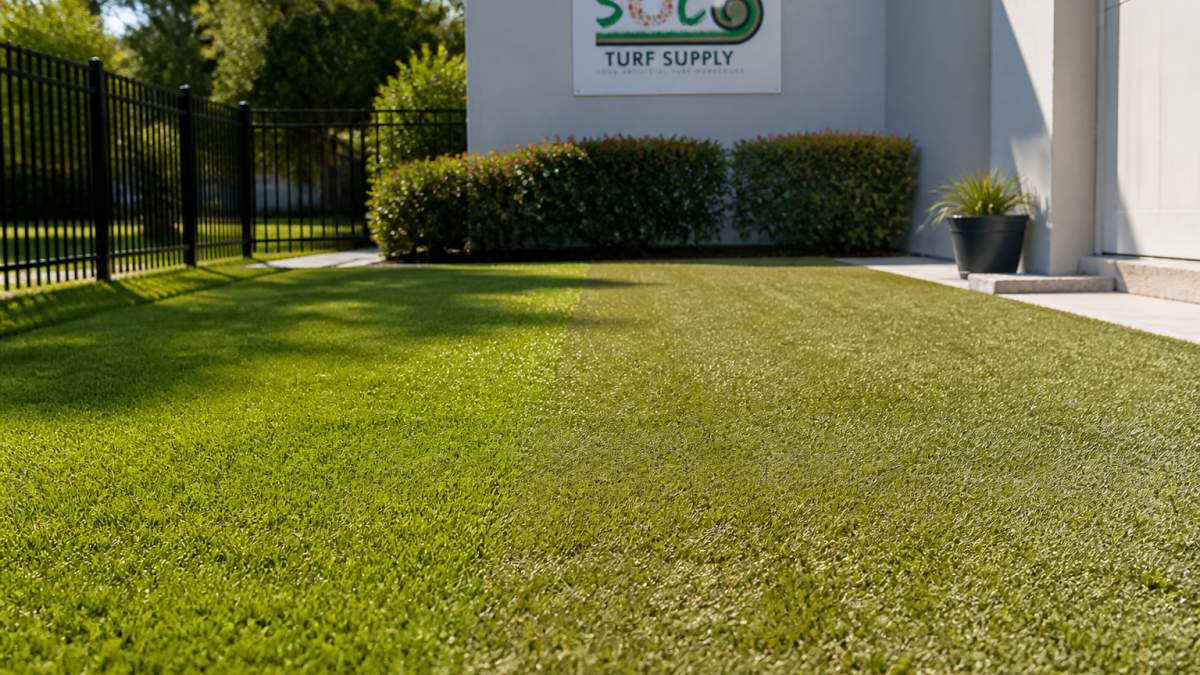
A crew installing artificial turf rolls on a graded base at a multifamily housing site in West Texas, with a skid steer and turf rolls in the background under bright daylight
The basic sequence:
- Clear and grade the area to the planned slope
- Excavate to the required depth for base and turf
- Install and compact the aggregate base in lifts
- Add a weed barrier over the compacted base
- Roll out turf and let it relax in the sun
- Trim edges and cut around fixtures
- Seam panels and secure edges
- Apply infill and power-broom the fibers upright
Drainage and Pet Area Odor Control
Drainage is the number one thing contractors ask us about, and it is the number one thing that goes wrong on cheap installs. Water has to move through the backing and out of the base, not sit under the turf.
For pet areas, odor control starts with the base and the infill, not with sprays. A properly compacted, free-draining base lets waste rinse through. Antimicrobial infill options help further. Where pets concentrate, a dedicated pet-zone product with a drainage-rated backing is worth the upgrade.
Artificial Turf Maintenance for Commercial Properties
Artificial turf maintenance for commercial properties is minimal, but it is not zero. A simple routine keeps the surface looking new and protects the investment.
What actually matters:
- Rinse the surface periodically to clear dust and debris
- Brush high-traffic areas to keep fibers upright
- Remove leaves and trash before they break down into the infill
- Check seams and edges once or twice a year
- Top off infill where it has settled or been displaced
That is the whole list for most properties. Compare it to mowing, edging, fertilizing, irrigating, and re-sodding, and the maintenance case makes itself.
One honest limitation: turf does get hot in direct sun. On playgrounds and pet areas, we recommend a lighter-colored product or a cooling infill to keep surface temps manageable. It is a real trade-off, not a dealbreaker.
Centers for Disease Control and Prevention guidance on heat and surface safety is worth reviewing if your project includes play areas.
Sourcing Artificial Turf in Midland, TX
Sourcing artificial turf in Midland, TX comes down to supply reliability and price transparency. Large housing projects cannot afford a supplier who runs short mid-install or quotes one price and invoices another.
This is where warehouse-direct buying changes the math. Cutting out the middleman means contractors get consistent pricing across phases of a project, plus the ability to reorder the same spec months later without a surprise.
What we bring to housing projects:
- UV-tested, performance-rated turf blends with documentation
- Warehouse-direct pricing with no middleman markup
- Turf, infill, seaming materials, and equipment rentals in one order
- Guidance on specs, quantity, and base depth before you buy
- Capacity to supply multi-site and large-scale developments
If you are searching for artificial turf near me for a housing project in the Permian Basin, the practical question is not who has the lowest sticker price. It is who can deliver the same product, on schedule, across every phase of the build.
Contractors we work with put it simply: their materials are consistent and dependable.
Conclusion
Housing projects in the Permian Basin need ground cover that survives heat, saves water, and holds up under real traffic. Getting the specs, base depth, and drainage right is what separates a surface that lasts from one that gets ripped out in three years.
Soco Turf Supply supplies UV-tested, performance-rated turf with warehouse-direct pricing, no middleman markup, and the installation materials and equipment rentals to finish the job. We work with contractors, developers, and property managers across Midland and the wider basin, from single courtyards to large-scale developments.
Get an estimate from Soco Turf Supply and spec your next project with turf that holds up.
Frequently Asked Questions
What should contractors consider when choosing artificial turf for a housing project?
Focus on face weight, pile height, backing type, and UV performance. Higher face weight (60 oz or more) holds up better under heavy foot traffic in shared spaces. Confirm the turf carries UV testing documentation you can show clients. Also match the product to the site: pet areas need drainage-friendly backing, while high-traffic walkways benefit from denser fibers. Soco Turf Supply provides performance-rated turf and can walk contractors through spec sheets before ordering.
How do you estimate artificial turf quantities for a multifamily development?
Measure each turf zone separately, then add 5-10% for cuts and seams. Account for odd shapes, planters, and walkway borders that create waste. For a large project, break the site into sections and total the square footage zone by zone rather than eyeballing the whole property. A project planning checklist helps you track quantities per building or phase so you can order in batches if needed.
What turf specifications matter most for shared residential outdoor spaces?
Face weight, pile height, backing drainage, and UV stability top the list. Shared spaces see constant foot traffic, so turf with higher face weight resists matting. Drainage backing matters in West Texas where heavy rain can pool quickly. UV-tested products hold color longer under intense sun. Ask for spec sheets that show these ratings so you can compare products on measurable data, not marketing language.
What maintenance does artificial turf need in multifamily housing?
Rinse pet areas weekly, brush high-traffic zones every few months, and remove debris after storms. Check infill levels annually and top off where needed. Inspect seams and edges each season for lifting. For commercial properties, a simple log of these tasks keeps the surface consistent across multiple buildings. Most crews handle this in a few hours per month, far less than mowing and irrigating natural grass.