
Table of Contents
- How to Diagnose Backyard Drainage Problems Before You Dig
- Yard Drainage Tools and Materials You’ll Need
- How to Regrade a Yard for Drainage
- French Drain Installation Cost and When to DIY vs Hire a Pro
- Building a Dry Creek Bed and Rain Garden for Surface Runoff
- Preventing Standing Water on Artificial Turf
- Permits, Maintenance, and Climate Considerations for Backyard Drainage
- Frequently Asked Questions
Last Updated: September 22, 2026
How to Diagnose Backyard Drainage Problems Before You Dig
Standing water after a storm is the clearest sign of a backyard drainage problem. This guide from Soco Turf Supply walks you through how to fix backyard drainage, starting with diagnosis so you solve the right problem.
Signs Your Yard Has a Drainage Problem
The most common signs of poor backyard drainage include:
- Puddles that sit for 24 hours or more after rain
- Soggy, spongy patches that never dry out
- Water pooling near your foundation or along a fence line
- Erosion gullies or bare spots in the lawn
- Mosquitoes breeding in standing water
- A musty smell or mold near the house
Any one signal means runoff is not moving away fast enough; two or more usually mean a subsurface problem too.
Testing Soil Percolation and Finding the Water Table
A percolation test tells you how fast your soil absorbs water. Dig a hole about 12 inches deep and wide, fill it, let it drain, then refill and time how long the second fill takes to disappear.
Yard Drainage Tools and Materials You’ll Need
Gather these yard drainage tools before you start:
- Shovel and trenching spade for digging
- Wheelbarrow for moving soil and aggregate
- Level and string line to check slope
- Tamper or plate compactor for soil compaction
- Perforated pipe for French drains
- Landscape fabric to keep soil out of gravel
- Catch basin and grate for low spots
- Drainage pipe and fittings to move water away
- Aggregate or gravel for backfill
- Topsoil for regrading and finishing
Rent trenchers and compactors for a one-time job. Soco Turf Supply offers equipment rentals alongside turf and installation materials.
How to Regrade a Yard for Drainage
Regrading reshapes your yard so water flows away from your home instead of pooling against it. Aim for a gentle 2% slope away from the foundation, roughly 2 inches of drop per 8 feet.
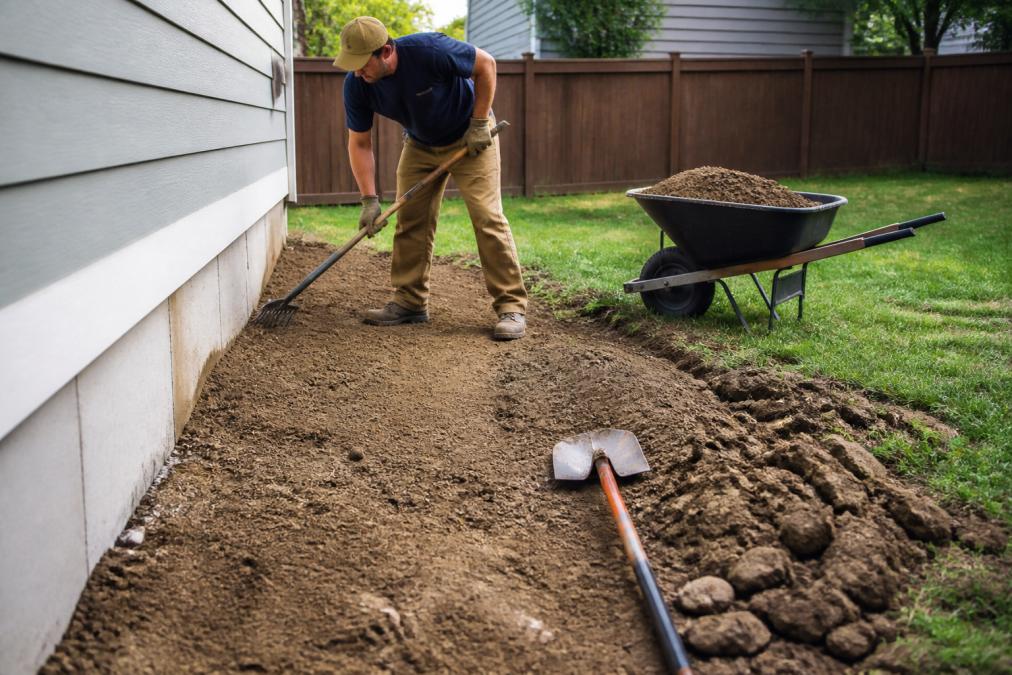
Here is how to regrade a yard for drainage:
- Mark the high and low points with stakes and string line.
- Remove sod and set it aside for reuse.
- Add or move topsoil to build the slope.
- Compact in thin layers, not one thick dump.
- Recheck the level every few feet as you go.
- Replace sod or seed once the grade is right.
Fixing Soil Compaction and Improving Percolation
Compacted soil is the hidden cause behind many drainage problems: foot traffic, heavy equipment, and construction press particles together until water cannot pass through.
French Drain Installation Cost and When to DIY vs Hire a Pro
French drain installation cost depends on length, depth, pipe diameter, aggregate volume, and whether you dig by hand or rent a trencher. Knowing what drives the price lets you sanity-check any bid.
What Drives the Cost
- Trench length and depth. A shallow 18-inch trench for a soggy lawn is a different job than a 36-inch trench chasing a high water table. Deeper trenches mean more excavated soil to haul, more aggregate to backfill, and more labor hours.
- Pipe and fittings. Rigid perforated PVC holds its slope better over long runs; flexible corrugated pipe is cheaper and faster to lay but sags and traps sediment if the trench bed is not smooth. Sock-wrapped pipe costs more up front and reduces clogging.
- Aggregate. Washed #57 stone or similar clean gravel is the standard backfill. The volume scales with trench width and depth, and delivery fees on bulk orders add up fast.
- Labor vs. rental. Hand digging is free but slow, a long run in clay can take a full weekend. Renting a walk-behind trencher for a day is often the single biggest time saver for a DIYer, but it requires access for the machine and a plan for the spoils.
- Disposal. Excavated soil has to go somewhere. On-site spreading is cheapest; hauling it off-site adds dump fees and truck time.
DIY vs. Pro: A Decision Framework
|
Situation |
Best Option |
Why |
|---|---|---|
|
Short run, easy soil, clear outlet |
DIY |
Low material cost, simple dig, low risk |
|
Long run or rocky ground |
Hire a pro |
Trencher access and labor save days |
|
High water table or wet-weather spring |
Hire a pro |
Needs careful design and outlet planning |
|
One soggy low spot |
DIY catch basin |
Quick, cheap fix without a full trench |
|
Drain must cross a driveway, patio, or utility line |
Hire a pro |
Trenchless methods and locating equipment matter |
|
Water must leave the property or tie to a storm system |
Hire a pro |
Permits and design review are usually required |
The break-even is rarely about the dollar figure alone. It is whether you can safely dig to depth, maintain a consistent fall, and discharge the water somewhere legal. If any of those three is uncertain, a pro usually costs less than a failed DIY trench.
Building a Dry Creek Bed and Rain Garden for Surface Runoff
A dry creek bed is a shallow, rock-lined channel that carries surface runoff across your yard without a pipe. Build it along the natural low path water already takes.
Preventing Standing Water on Artificial Turf
Standing water on artificial turf almost always traces back to the base, not the turf. Turf drains through its backing into the base layer below; if that base is flat or compacted, water has nowhere to go.
Preventing standing water on artificial turf starts at installation:
- Build a sloped, compacted base of crushed aggregate
- Use a base depth that suits your soil and rainfall
- Install a drainage layer or perforated pipe under low spots
- Keep the infill porous and free of compacted debris
- Check downspout extensions so roof water exits away from the turf
Permits, Maintenance, and Climate Considerations for Backyard Drainage
Most guides stop at installation, skipping the three things that determine whether your drainage fix still works in five years: permits, maintenance, and climate fit.
Permits and Legal Limits on Moving Water
Permit rules vary by city and county, so check with your local building department before you dig. The general pattern across most jurisdictions:
- Grading permits are commonly required when you move more than a threshold volume of soil or change the grade near a foundation or property line.
- Storm system connections almost always require approval. Tying a yard drain into a municipal storm sewer without a permit is a common violation.
- Discharge rules often prohibit sending water onto a neighbor’s property or into a sanitary sewer. Some areas require an on-site infiltration or retention solution instead.
- Utility locating is not optional. Call 811 before you dig so buried gas, electric, water, and fiber lines are marked. This is free in most states and required by law in many.
- HOA covenants can be stricter than the city. Many associations restrict visible drainage features, require screening, or ban discharge toward shared property. Read the covenants before you buy materials, not after.
A Maintenance Schedule That Prevents Clogs
A drainage system is not install-and-forget. Sediment, roots, and debris will find the low points. A simple schedule keeps it working:
- Before each rainy season: clear catch basins, grates, and channel drain covers of leaves and grit.
- Twice a year: inspect the outlet. If water is not exiting, the problem is usually at the discharge end, not the inlet.
- Annually: flush perforated pipe with a hose or pressure washer from the downstream end. If flow reverses or backs up, a clog has formed.
- After major storms: recheck slope and grade. Settling and erosion can undo a 2% fall in a single season.
- Every few years: inspect landscape fabric. Once it is blinded with fine sediment, it stops passing water and needs replacement.
- Seasonally: trim rain garden plants and remove accumulated sediment from the basin so it can still pond and infiltrate.
Climate and Soil: Why One Fix Does Not Fit All
Soil type and rainfall pattern change which solution actually works:
- Heavy clay soil. Percolation is slow, so surface fixes alone rarely solve the problem. Combine regrading and a French drain with organic matter amendments to open the soil structure. A rain garden in clay needs an engineered soil mix, not native dirt, or it will just hold water.
- Sandy soil. Water moves fast, sometimes too fast. Infiltration is easy, but erosion and nutrient leaching are the risks. Use dry creek beds and permeable surfaces rather than large infiltration basins.
- High water table. Surface grading will not help. Subsurface drainage with a defined outlet is the only reliable fix, and it usually needs a pro to design.
- Hot, arid regions. Soil can bake hard and shed water instead of absorbing it. Organic matter, mulch, and permeable pavers help restore infiltration.
- Heavy rainfall regions. Size drainage for the heaviest storms, not the average. A system designed for a typical rain will overflow in a 10-year event.
DIY vs. Pro: The Real Break-Even
DIY suits small, simple fixes: a catch basin at one low spot, a short dry creek bed, aerating and amending a compacted lawn. Larger jobs, grading near a foundation, long trench runs, high water tables, or any work touching a storm connection, usually cost less when a pro handles them once, correctly. The break-even is not just money; it is the cost of a failed fix, a permit violation, or water redirected onto a neighbor’s lot.
Frequently Asked Questions
What can I do to fix my waterlogged backyard?
Start by diagnosing the cause: check for soil compaction, poor grading, or a high water table. For surface runoff, regrade the yard to slope away from the foundation at a 2% minimum. For subsurface issues, install a French drain or trench drain to redirect groundwater. Aerating compacted soil and adding organic matter improves percolation. In the Permian Basin’s clay-heavy soils, combining a dry creek bed with a rain garden often handles both surface and subsurface water without major excavation.
Can I dig a hole and fill it with gravel for drainage?
A gravel-filled hole, sometimes called a dry well, can work for small volumes of water but fails in clay soils where percolation is slow. The hole fills faster than it drains, creating a permanent soggy spot. A better approach is a perforated pipe French drain that carries water to a lower discharge point, or a catch basin connected to a drainage pipe. Test percolation first: if water in a 12-inch hole doesn’t drop 1 inch per hour, gravel alone won’t solve backyard drainage.
How do I know if my yard has poor drainage?
Standing water 24 hours after rain, soggy patches, mosquito swarms, and foundation cracks are the clearest signs. Look for surface runoff that pools near downspouts or slopes toward the house. Check for soil compaction by pushing a screwdriver into the ground; if it resists past 2 inches, roots and water can’t penetrate. Musty odors or yellowing grass in low spots also point to a drainage problem that needs grading or a subsurface drainage system.
When should I hire a professional for yard drainage?
Hire a pro when the problem involves the water table, hydrostatic pressure against a foundation, or a drainage ditch that crosses property lines. If you need a culvert or permit for discharging water into a municipal system, a licensed contractor handles the paperwork. French drain installation cost varies with trench length, pipe diameter, and aggregate volume, so get quotes for anything over 100 feet. For small regrading and downspout extensions, DIY is usually sufficient.
Fixing backyard drainage is really a diagnosis problem, not a digging problem. Find the root cause first, then match the fix to your soil, slope, and climate. Soco Turf Supply supports the job with UV-tested, performance-rated turf, warehouse-direct pricing, and equipment rentals, so contractors and homeowners can finish projects efficiently. Get your estimate from Soco Turf Supply and build a yard that drains right the first time.