Last Updated: November 19, 2026
Quick Summary
Xeriscaping usually costs more to install than natural grass, but it can cost less to keep up over the years. Whether xeriscaping cheaper overall holds for your yard depends on your water rate, your current mowing and fertilizing spend, and how long you plan to stay. The break-even point varies from yard to yard.
- Xeriscape installation is priced by component: weed barrier, edging, aggregate rock, mulch, plants and labor.
- Natural grass is often cheaper to establish per square foot than a xeriscape bed.
- Natural grass carries recurring costs for mowing, edging, fertilizing, aeration and weed control.
- Water rates are the cost most likely to change the answer, so check your recent water bill.
- Compare both options over the same square footage and time horizon to find the break-even year.
Table of Contents
- Is Xeriscaping Cheaper Than Natural Grass? The Short Answer
- Upfront Installation Costs: Xeriscape Versus Natural Grass
- Water Rates and Irrigation Costs in Midland
- Annual Maintenance: Mowing, Fertilizing, and Weed Control
- Side-by-Side Lifecycle Cost Model for a Typical Midland Yard
- West Texas Conditions That Change the Math
- Planning Your Own Break-Even Analysis
- Frequently Asked Questions
Is Xeriscaping Cheaper Than Natural Grass? The Short Answer
Xeriscaping usually costs more to install than natural grass, but it can cost less to keep up over the years. Whether it comes out ahead for your yard depends on your water rate, how much mowing and fertilizing you do now, and how long you plan to stay in the house. The math can favor low-water landscaping once ongoing expenses are counted, though the exact break-even point varies from yard to yard.
Soco Turf Supply works with homeowners, contractors and property managers across the Permian Basin. The sections below walk through the cost categories that matter and explain where the numbers can swing.
Upfront Installation Costs: Xeriscape Versus Natural Grass
Upfront cost is where xeriscaping usually loses the first round. You can see what a residential turf or landscape installation typically runs before you decide. A xeriscape bed is built from several priced components, weed barrier, edging, aggregate rock, mulch, and the plants themselves, and each one is quoted separately, so the installed cost per square foot climbs faster than most homeowners expect. Natural grass is often cheaper to establish on a per-square-foot basis than a xeriscape bed.
A useful way to read a xeriscape bid is to break it into its parts rather than accept a single blended number:
- Weed barrier and edging. Fabric and steel or plastic edging are priced by the linear foot and by the roll. Edging is what keeps rock from migrating into the lawn and keeps grass from invading the bed, so it is not a place to cut corners.
- Aggregate rock. Rock is sold by the ton or by the cubic yard, and the delivered price depends on the material, the haul distance, and how deep the bed is specified. Deeper rock beds cost more in material and in labor to spread.
- Mulch. Mulch is priced by the cubic yard and is usually the cheapest bulk component, but it needs to be re-topped periodically, which is a recurring cost rather than a one-time one.
- Plants. Plant cost is the wild card. A bed built from small, drought-tolerant starts costs far less than one built from larger specimen plants, and the difference in establishment time and replacement risk is significant.
- Design and labor. A complex layout with curves, boulders, and multiple bed depths takes more labor hours than a simple rectangular bed of the same square footage.
Artificial turf is a separate category with its own installed cost, driven by the turf grade, the base preparation, and the infill.
Watch out: Ordering rock or mulch before the bed layout is finalized is the most common cause of reorders, extra delivery charges, and leftover material. Measure the bed, sketch it, and confirm the depth specification before you place a bulk order.
Because material pricing depends on quantity, delivery distance, and the date of the order, a quote built on your actual square footage and layout gives the most reliable upfront number. Request a quote for your measured area.
Water Rates and Irrigation Costs in Midland
Water is the cost most likely to change your answer. Natural grass in West Texas needs regular irrigation to stay green, and a lawn that runs sprinklers several times a week can add a noticeable amount to the monthly water bill. Xeriscaping, by contrast, is designed to rely on far less supplemental water once it is established.
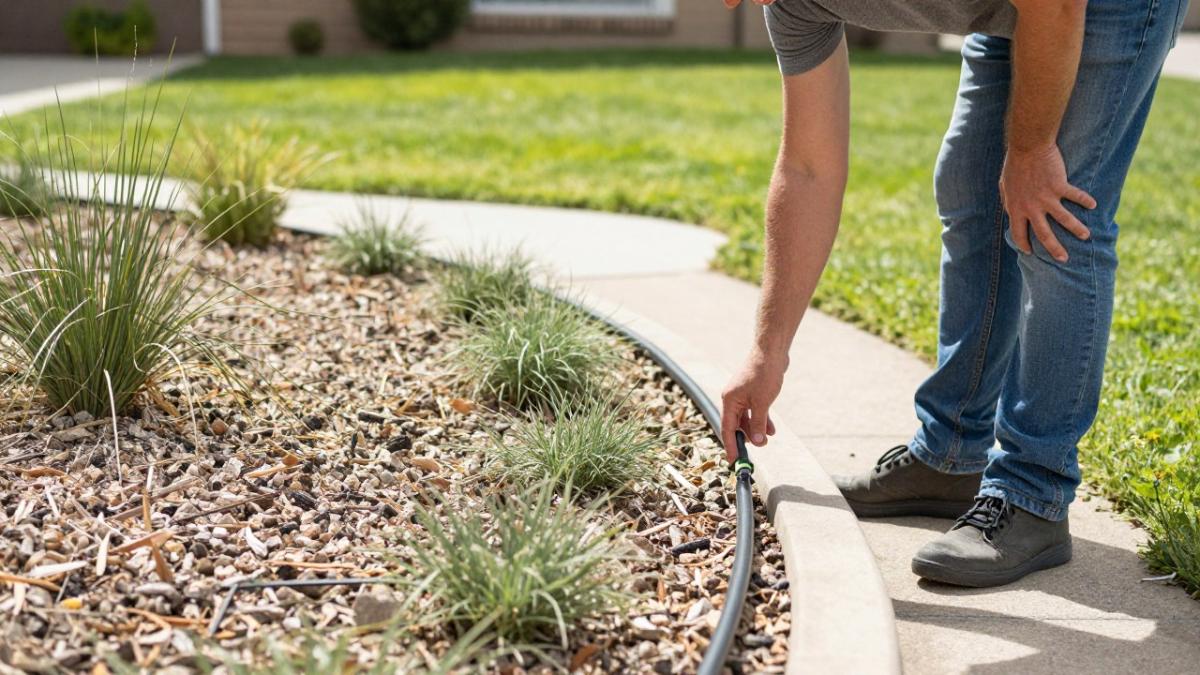
To estimate your own exposure, pull a recent water bill and note your current rate structure. Then compare your summer usage against a winter month to see how much of your bill comes from irrigation. Local water utility rates and any drought restrictions can change over time, so check current figures directly with your provider.
Annual Maintenance: Mowing, Fertilizing, and Weed Control
Natural grass carries recurring labor and material costs. Mowing, edging, fertilizing, aerating, overseeding and weed control all add up across a growing season.
Xeriscaping reduces most of that work. Plant beds still need occasional weeding, and mulch may need topping off, but the mowing schedule disappears. Artificial turf removes mowing and fertilizing almost entirely, though it still benefits from periodic brushing and occasional rinsing to keep it looking good.
Side-by-Side Lifecycle Cost Model for a Typical Midland Yard
Most comparisons stop at a qualitative table. A real lifecycle model puts the same yard size and the same time horizon on both sides and itemizes every line, so the break-even point falls out of the assumptions instead of being asserted. The framework below is built for a typical Midland residential yard; plug in your own figures for each line.
Step 1, Fix the assumptions. Write down four numbers before comparing anything: the square footage of the area being converted, your current water rate structure (including any tiered or seasonal pricing), your annual spend on mowing and fertilizing, and the number of years you expect to own the property. Every later calculation depends on these four inputs, so keep them visible.
Step 2, Itemize the upfront lines. For each option, list installed cost for weed barrier, edging, aggregate rock, mulch, plants, design, and labor. For natural grass, list the establishment cost for the same square footage. For artificial turf, list turf, base, infill, and installation. Do not blend these into one number, the line items are what let you see where a quote is heavy.
Step 3, Itemize the annual lines. For natural grass, list irrigation water, mowing, edging, fertilizing, aeration, and weed control. For xeriscaping, list occasional weeding, mulch top-off, and any plant replacement. For artificial turf, list brushing, rinsing, and infill refresh. Convert each to an annual figure using your own bills and service quotes.
Step 4, Build the cumulative table. The table below is the structure, not the answer. Fill each cell with your own numbers and add a cumulative column for each year of the horizon.
| Line item | Natural Grass | Xeriscaping | Artificial Turf |
|---|---|---|---|
| Upfront: barrier, edging, rock, mulch | Not applicable | Annualized over horizon | Not applicable |
| Upfront: plants or establishment | Establishment cost | Plant cost | Not applicable |
| Upfront: turf, base, infill | Not applicable | Not applicable | Installed cost |
| Annual: irrigation water | Highest | Low | None |
| Annual: mowing and edging | Recurring | Minimal | None |
| Annual: fertilizing and weed control | Recurring | Periodic | Minimal |
| Annual: mulch top-off or infill refresh | Not applicable | Periodic | Periodic |
| Cumulative cost, year 1 through year N | Sum | Sum | Sum |
Step 5, Find the crossover year. The break-even year is the first year in which the cumulative xeriscape total drops below the cumulative natural-grass total. Because the xeriscape side starts higher and grows more slowly, the crossover year is highly sensitive to two inputs: your water rate and your current maintenance spend. A household that mows and fertilizes itself has a later crossover than one that pays a service.
Step 6, Stress-test the result. Re-run the model with a higher water rate and with a lower one. If the crossover year moves by more than a year or two, the decision is being driven by water price rather than by installation cost, and that is worth knowing before you commit.
Watch out: Comparing a full-yard xeriscape quote against a partial-yard grass cost is the most common modeling error. Both sides must cover the same square footage and the same time horizon, or the break-even year is meaningless.
Partial conversion is a legitimate middle path in this model. Converting only the highest-water or lowest-use areas, a front strip, a slope, a section the household never uses, captures part of the savings while keeping the rest of the yard as-is. Run the same six steps on the converted square footage alone to see whether the partial project pays back faster than a full conversion.
Once your assumptions and line items are in place, compare the result against a quote built on your measured square footage to see how your project fits the model. Get Estimate.
West Texas Conditions That Change the Math
Midland’s climate shapes the comparison. Here is how turf installation works in West Texas conditions. Summers are hot and dry, winds are strong, and soils often drain quickly. Natural grass in these conditions tends to need more water and more attention to stay healthy, which raises the ongoing cost side of the ledger.
Plant selection also matters. Drought-tolerant and native plants generally perform better here than species suited to wetter regions. Artificial turf handles heat differently, and surface temperatures can climb in full sun, so placement and shading are worth considering before installation. Read about protecting a surface from heat damage in Midland.
Planning Your Own Break-Even Analysis
A useful break-even analysis starts with clear assumptions. Measure your yard in square feet, estimate your current annual water and maintenance spend, and get installation quotes for each option you are considering. You can find local landscape supply sources to check materials pricing as you build your numbers. Then calculate how many years it takes for the lower ongoing cost to offset the higher upfront cost.
Keep the assumptions visible. If your water rate rises, or if you decide to hire less maintenance help, the break-even point moves. Partial conversion is also an option. Some homeowners convert only part of a yard and keep natural grass elsewhere.
Once you have your numbers, request a quote from Soco Turf Supply to compare against your project.
Choosing between xeriscaping and natural grass comes down to how much you want to spend upfront and how much you want to spend over time. For Midland yards, the ongoing savings often justify the larger initial investment, but the right answer depends on your specific numbers. Soco Turf Supply is ready to help you build that comparison and find the option that fits your yard.
Frequently Asked Questions
Is xeriscaping cheaper than natural grass in the long run?
Often, yes, but the answer depends on yard size, how much you would otherwise spend on water, mowing, fertilizer and weed control, and how the upfront installation is priced. Xeriscaping usually costs more to install because of plant material, rock, mulch and design work. Over time, lower irrigation and maintenance expenses can narrow or close that gap. Soco Turf Supply recommends requesting a quote for your specific project, since pricing depends on quantity, dates, and delivery.
How much water can xeriscaping save compared with a lawn?
Savings vary with the plants chosen, the irrigation system, and how often a traditional lawn is watered in the Midland heat. Well-selected drought-tolerant and native plants generally need far less supplemental watering once established. Establishment still requires regular watering for the first season. Checking your current water bill over a full year gives you a practical baseline for comparison.
What is the cheapest way to xeriscape a yard in Midland?
Phasing the project is usually the most budget-friendly approach. Converting one section at a time lets you spread out costs and test which plants thrive in your soil and wind exposure. Using mulch and hardy, adapted plants instead of expensive specialty materials can also reduce spending. Ask Soco Turf Supply about current options and a quote before committing to materials.
How long does it take for xeriscaping to pay for itself?
Payback depends on the initial installation cost, your current water and maintenance spending, and how much of the lawn you convert. Because those inputs differ from yard to yard, a break-even estimate should use your own numbers. Build a simple comparison that lists upfront cost, annual water use, and annual upkeep for each option, then see where the lines cross. Requesting a project quote from Soco Turf Supply can help you start that calculation.
