Table of Contents
- What Residential Artificial Turf Installation Cost Actually Covers
- Artificial Turf Price Per Square Foot: What Changes the Number
- Turf Sub-Base Preparation Costs and Drainage Engineering
- DIY vs Professional Turf Installation: Real Cost Comparison
- Artificial Turf Maintenance Requirements and Long-Term Savings
- Permits, HOA Rules, and Environmental Impact
- Warranty, Lifespan, and ROI: What You Get Back
- Verdict: Budgeting for Your Residential Turf Project
- Frequently Asked Questions
Last Updated: September 25, 2026
What Residential Artificial Turf Installation Cost Actually Covers
Residential artificial turf installation cost is the total of every material and labor input required to convert a bare or failing yard into a finished, usable surface. At Soco Turf Supply, we see homeowners assume the turf roll is the whole bill. It rarely is.
A typical quote bundles four cost centers:
- Turf material, priced by the square foot and graded by face weight and backing
- Sub-base materials, including base aggregate, weed barrier, and infill
- Equipment, from plate compactors to power brooms and seam cutters
- Labor, the single largest variable in most projects
Line Items That Drive Your Total Project Cost
Every line item scales with yard size, access, and ground conditions. A flat, cleared 500 square foot area behaves nothing like a sloped, tree-rooted 2,000 square foot one.
| Line Item | What Drives It | Where Costs Hide |
|---|---|---|
| Turf material | Face weight, pile height, fiber type | Cheap backing that fails early |
| Base aggregate | Depth required, compaction | Insufficient depth causing ripples |
| Weed barrier | Grade and overlap | Skimping on seams |
| Infill | Type and volume | Underfilled blades that mat down |
| Labor | Square footage, access, complexity | Removal of old material |
| Equipment | Rental duration | Multiple mobilization trips |
Artificial Turf Price Per Square Foot: What Changes the Number
Artificial turf price per square foot varies widely because the product itself is not one product. Two rolls that look identical from ten feet away can differ by years of usable life.
Face Weight, Pile Height, and Fiber Type
Three specifications decide how a turf performs. Ask for all three in writing before you compare quotes.
- Face weight measures the ounces of fiber per square yard. Higher face weight means denser, more durable turf.
- Pile height is blade length, usually expressed in millimeters. Taller blades look plusher; shorter blades wear longer under heavy use.
- Fiber type determines softness and resilience. Polyethylene is soft and common in lawns. Polypropylene is stiffer and used in putting greens. Nylon is the most durable and the most expensive.
Ask any supplier for the UV stabilization documentation and the performance rating on the specific roll you are buying, not the product family. The spec sheet for the line is not the spec sheet for your order.
Turf Sub-Base Preparation Costs and Drainage Engineering
Turf sub-base preparation costs are the most underestimated part of any budget, and they are also the part that determines whether the surface drains or puddles.
Base Aggregate, Excavation, and Site Grading
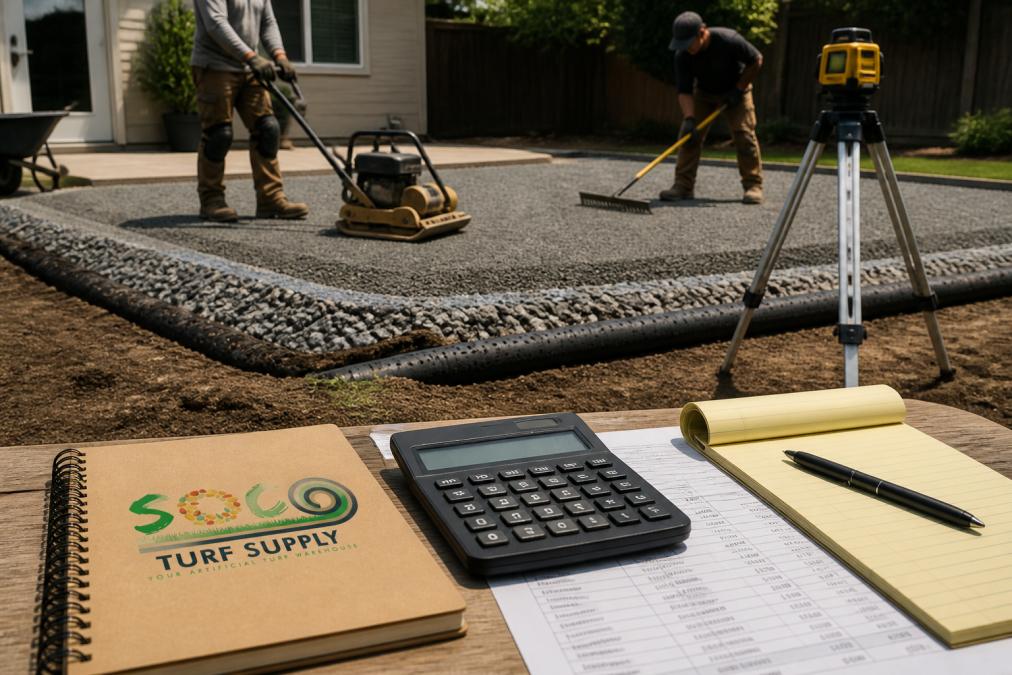
The sub-base is a layered system. Each layer has a job.
- Excavation removes existing material to the correct depth. Deeper turf means deeper digging.
- Site grading establishes slope so water moves away from structures, not toward them.
- Base aggregate is crushed stone compacted in lifts. Depth depends on soil and drainage needs.
- Weed barrier sits above the base to block growth from below.
- Infill is broadcast into the blades to add weight and stability.
Skipping or thinning the base aggregate to save on material is the single most common cause of ripples, seams that separate, and standing water after rain. Fixing it later means removing the turf and starting the sub-base over.
DIY vs Professional Turf Installation: Real Cost Comparison
- Excavation and haul-off. You remove existing material to depth, then pay to dispose of it. Rental dumpsters and landfill or transfer-station fees are per load, and soil is heavy. This is the line item DIY budgets forget first.
- Base aggregate delivery. Crushed stone arrives by the cubic yard. You need enough for the compacted depth your soil and drainage require, plus a margin for compaction loss. Short loads mean a second delivery fee.
- Compaction equipment. A plate compactor is the minimum. A vibratory roller is better for larger areas. Rental is priced per day, and a weekend project that slips to three weekends triples that line.
- Grading and laser level. Slope has to move water away from the house. Without a laser level, you are eyeballing a surface that will show every low spot once turf is down.
- Seaming tools and adhesive. Seam cutter, seam tape, and adhesive are separate purchases. A poorly glued seam is visible from the second story.
- Infill and a power broom. Infill has to be broadcast evenly and brushed into the blades. A stiff push broom works on small areas; larger yards need a power broom rental.
- Turf cutting and trimming. Edges around hardscape, planters, and structures are hand-cut. This is where DIY timelines blow out.
| Factor | DIY | Professional |
|---|---|---|
| Labor | Your time, weekends and evenings | Crew labor, scheduled completion |
| Equipment | Rental, priced per day, multiple trips likely | Included in quote, one mobilization |
| Base prep | Highest risk area; compaction is hard to verify | Engineered, compacted in lifts, documented |
| Seaming | Visible if done poorly | Hidden and reinforced |
| Disposal | You arrange haul-off and pay per load | Bundled into the quote |
| Timeline | Weeks of partial weekends | Days |
| Rework risk | High; base failures surface within a season | Low; covered by installation warranty |
If you cannot verify compaction, with a plate compactor run in overlapping passes over moistened aggregate in shallow lifts, do not proceed to turf. Ripples and standing water appear within the first rainy season, not immediately, so the mistake is invisible until it is expensive.
For homeowners who want the material quality of a professional job without the markup, Soco Turf Supply offers warehouse-direct pricing on UV-tested, performance-rated turf and the installation materials that go with it.
Artificial Turf Maintenance Requirements and Long-Term Savings
Artificial turf maintenance requirements are minimal compared to a living lawn, and that is where the long-term math turns in turf’s favor.
Routine care is mostly housekeeping:
- Rinse the surface periodically to clear dust and debris
- Brush high-traffic areas to keep blades upright
- Remove leaves and organic matter before they break down
- Address pet waste promptly and rinse the area
- Check seams and edges once a season
Permits, HOA Rules, and Environmental Impact
Permits and HOA rules can add cost and delay that no material quote will show you. Check both before you order turf.
Confirm HOA approval and any local permit requirements before you place a material order. A rejected installation is the most expensive kind.
Warranty, Lifespan, and ROI: What You Get Back
Warranty and lifespan are the numbers that decide whether turf pays for itself, and almost no guide on the SERP actually walks through the math. Here is the framework.
The Cost-Per-Year Calculation
The honest way to compare a turf quote against a living lawn is cost per year of service life, not sticker price. A well-installed surface with quality turf and a properly compacted base will outlast a cheap installation by years. Divide your total installed cost by the expected service life, and you get a number you can compare against the recurring costs you stop paying.
What Voids a Warranty
Warranty coverage varies by manufacturer, and the exclusions matter more than the headline term. The exclusions most commonly cited:
- Improper sub-base. Insufficient aggregate depth, no compaction, or no weed barrier.
- Improper drainage. Water that pools or backs up under the turf.
- Chemical damage. Some herbicides, solvents, and fertilizers degrade backing and fibers.
- Improper installation. Seams glued with the wrong adhesive, edges not secured, infill not broadcast.
- Heat damage. Reflective glare from low-E windows can melt fibers in concentrated spots.
- Failure to document. No spec sheets, no base depth records, no installation photos.
The ROI Case
The ROI case rests on what you stop paying for: irrigation, mowing, fertilizer, and replacement plantings. Over a long horizon, those recurring costs are what turf replaces. For households in a hot, dry climate, the eliminated irrigation is often the largest ongoing saving, and it is the one that compounds every year the surface stays in service.
Keep your material spec sheets, your base depth records, and your installation photos. If you ever file a warranty claim, documentation is what gets it approved. Store them somewhere you will still find them in ten years.
The number that matters is cost per year of service life, not cost per square foot. A quote that is higher upfront but documented, warranted, and built on a proper base is usually the cheaper surface over its full life.
Verdict: Budgeting for Your Residential Turf Project
Budget in this order: sub-base first, turf second, labor third. Homeowners who reverse that order are the ones who pay twice.
Frequently Asked Questions
What factors influence the total cost of residential artificial turf installation?
Square footage drives most of it, but the artificial turf cost also depends on turf quality (face weight and pile height), sub-base depth and drainage work, excavation and haul-away, seaming and infill, labor rates, and whether you add a putting green or pet-friendly turf system. Permits and HOA requirements can add fees. Get an itemized quote so you can see which line items are fixed and which scale with project size.
How does artificial turf price per square foot change with project size?
Larger projects usually lower the per-square-foot rate because mobilization, equipment, and labor setup spread across more area. Small backyard jobs carry a higher rate per square foot since fixed costs do not shrink. Ask suppliers for tiered pricing at different square footages so you can see where the rate drops, and confirm whether delivery and base aggregate are included or billed separately.
Is DIY turf installation really cheaper than hiring a pro?
DIY saves on landscaping labor, but you still pay for turf, base aggregate, weed barrier, infill, seaming materials, and equipment rentals. The gap narrows fast if you lack a plate compactor, laser level, or a truck for hauling. Poor sub-base prep causes wrinkles, drainage failures, and premature wear, which costs more to fix than the labor you saved. Compare your full material and rental list against a professional quote before deciding.
What are the drawbacks of artificial turf?
Upfront cost is higher than a bare dirt or gravel yard. Surface temperatures run hotter than natural ground in direct sun, so shade or cooling infill helps in exposed areas. Pet areas need regular rinsing and a drainage system designed for waste. Cheaper turf with low UV stabilization can fade or get brittle in intense heat, so verify face weight and UV testing before buying.
Does artificial turf increase home value?
It can support curb appeal and marketability, especially in drought-prone markets where buyers want low-maintenance, water-saving landscaping. Appraisers weigh it as a landscaping feature, not a structural upgrade, so the bump varies by neighborhood. The stronger financial case is the ROI from avoided water bills, mowing, and replacement costs over the turf’s lifespan, plus the durability that holds up under heavy foot traffic.
The hardest part of a turf project is not choosing a color. It is getting the sub-base, drainage, and seams right so the surface still looks new in five years. Soco Turf Supply supports that work with warehouse-direct pricing, performance-rated turf blends, and a full supply of turf, materials, and equipment rentals, backed by guidance from a team built alongside construction expertise. Get your estimate from Soco Turf Supply and start your project with materials that hold up.