Table of Contents
- Why UV Testing Decides How Long Turf Lasts in the Permian Basin
- How Artificial Turf UV Resistance Testing Works
- Reading an Artificial Turf Data Sheet UV Rating
- Artificial Grass Colorfastness Testing: Will It Fade?
- What an Artificial Turf Weathering Test Actually Simulates
- Questions to Ask a Turf Supplier Before You Buy
- Frequently Asked Questions
Last Updated: October 13, 2026
Why UV Testing Decides How Long Turf Lasts in the Permian Basin
Walk past a faded, chalky patch of artificial grass in Midland and you are looking at failed turf UV testing, whether the owner knew it or not. Artificial turf UV testing standards explained properly come down to one idea: ultraviolet radiation breaks down the polymers that give synthetic grass its color and strength, and a test result tells you how well a specific product resists that breakdown. In the Permian Basin, where relentless sun and high summer temperatures accelerate that process, UV performance is the single biggest predictor of whether turf still looks sharp after a decade or turns brittle and gray in a few seasons.
At Soco Turf Supply, we field questions every week from homeowners and contractors in Midland who watched a neighbor’s cheap turf fail and want documentation before they spend a dime. That is the right instinct. This guide walks through the test methods, how to read a data sheet, and what to ask before you buy.
The stakes are higher here than in milder climates. A product rated for a cloudy coastal market may not hold up under West Texas sun. Understanding the tests is how you avoid paying twice.
How Artificial Turf UV Resistance Testing Works
Artificial turf UV resistance testing measures how a turf sample holds up when exposed to controlled ultraviolet light, then compares its color and physical integrity against an unexposed control. Manufacturers place samples in a laboratory weathering chamber and cycle them through UV light, heat, and moisture to mimic years of sun exposure in a compressed timeframe.
Two things get measured: color change and physical degradation. Color change is graded against a standardized scale, while physical degradation tracks whether the fibers crack, split, or lose tensile strength. A product that passes color testing but fails durability testing will still shed fibers and flatten underfoot.
The chamber does not use actual sunlight. It uses fluorescent UV lamps tuned to the wavelengths that do the most polymer damage. That is a feature, not a flaw: it makes results repeatable across labs.
The Two Test Methods You Will See Most Often
The two dominant methods are QUV accelerated weathering and xenon-arc testing. QUV uses fluorescent UV lamps and is the workhorse for most turf manufacturers because it is fast and inexpensive. Xenon-arc testing uses a lamp that more closely reproduces the full solar spectrum, including visible light, and is generally considered a closer simulation of real-world sun.
|
Test Method |
Light Source |
Best For |
Trade-off |
|---|---|---|---|
|
QUV accelerated weathering |
Fluorescent UV lamps |
Fast screening, most turf products |
Narrower light spectrum |
|
Xenon-arc testing |
Xenon arc lamp |
Full-spectrum simulation |
Slower, higher cost |
|
Outdoor exposure |
Actual sunlight |
Real-world validation |
Takes years |
Neither method is “better” in isolation. What matters is that the manufacturer states which method was used and for how many hours, because the numbers are not interchangeable between methods.
Reading an Artificial Turf Data Sheet UV Rating
An artificial turf data sheet UV rating is only useful if you know which number you are looking at. Most sheets list a UV exposure duration in hours, a colorfastness grade, and the test standard referenced. A high hour count with no stated method is a red flag.
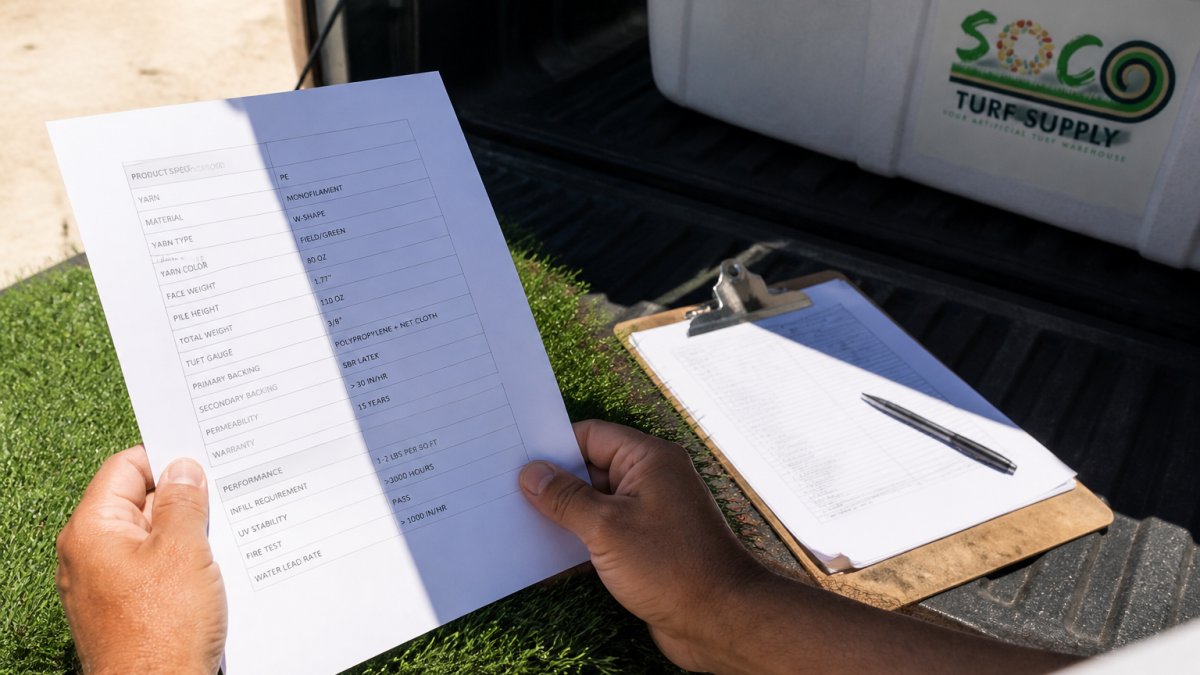
Here is what to look for, and what to ignore.
Numbers That Matter and Numbers That Do Not
What matters: the test method, the exposure duration in hours, the colorfastness grade, and whether the fiber’s tensile strength was measured after exposure. What does not matter: a vague “UV stabilized” claim with no test reference, or a marketing phrase like “UV protected” that appears nowhere in the technical documentation.
- Method named (QUV or xenon-arc): required for the number to mean anything
- Exposure hours: the higher the better, but only comparable within the same method
- Colorfastness grade: typically reported on a standardized gray scale
- Post-exposure tensile data: proves the fiber did not just hold color but stayed strong
- Third-party lab name: in-house-only testing is weaker evidence
Artificial Grass Colorfastness Testing: Will It Fade?
Artificial grass colorfastness testing answers the fading question directly by measuring how much a turf sample’s color shifts after UV exposure. The result is graded on a standardized scale, with higher grades indicating less visible change. A turf that grades well here will hold its green through years of Permian Basin summers; one that grades poorly will drift toward gray or yellow.
Colorfastness is separate from physical durability, and this is the part most buyers miss. A fiber can keep its color while slowly losing tensile strength, which shows up later as shedding, splitting, and a surface that feels rough and brittle. Ask for both numbers.
For Midland properties specifically, fading risk runs higher than in cooler markets because UV intensity and heat work together. Heat alone does not break down the polymer the way UV does, but it accelerates the reaction. That combination is why a product with a modest rating may perform acceptably in a mild climate and fail here.
What an Artificial Turf Weathering Test Actually Simulates
An artificial turf weathering test simulates the combined assault of sunlight, heat, and moisture over an accelerated timeline. A weathering chamber cycles a sample through UV exposure, elevated temperature, and condensation or water spray, then repeats the cycle for hundreds or thousands of hours.
The moisture component matters more than people expect. In a real installation, dew, rain, and irrigation introduce water that interacts with UV damage. A chamber that only blasts UV light without moisture cycles is testing an incomplete picture. According to ASTM International standards for accelerated weathering, standardized weathering tests are designed to reproduce these combined environmental stresses so results are comparable across labs and products.
What the test cannot fully simulate is installation quality. Poor drainage, inadequate infill, and bad seaming shorten turf life regardless of how well the fiber tested. That is why we tell contractors in Midland that a strong UV rating is necessary but not sufficient.
Questions to Ask a Turf Supplier Before You Buy
Ask for the test method, the exposure duration, the colorfastness grade, and third-party lab documentation, in writing, before you commit. A supplier who can produce those answers quickly is a supplier who knows their product. One who deflects to “it’s UV stabilized, don’t worry about it” is telling you something too.
The U.S. Federal Trade Commission guidance on environmental marketing claims is clear that performance and environmental claims must be substantiated, which is exactly why documentation requests are reasonable rather than pushy. You are not being difficult. You are asking for the evidence behind the claim.
Here is the checklist we hand to customers in Midland:
- Which test method was used: QUV or xenon-arc?
- How many exposure hours, and at what cycle settings?
- What colorfastness grade was recorded?
- Was post-exposure tensile strength measured?
- Which third-party lab ran the test, and can I see the report?
- Does the warranty on fading reference a specific test result?
- How does the product handle heat combined with UV, not UV alone?
Soco Turf Supply stocks UV-tested, performance-rated turf blends and provides the documentation contractors need to show clients. If you are sourcing turf near me in Midland or anywhere across the Permian Basin, we can walk you through the ratings on each product and match the right blend to your sun exposure, traffic level, and project size.
Fading and brittleness are the two failure modes that turn a turf investment into a repeat purchase, and both trace back to UV performance you can verify before installation. Soco Turf Supply supplies UV-tested, performance-rated turf with warehouse-direct pricing, so you skip the middleman and get documentation you can hand to a client. Our team also stocks the installation materials and equipment rentals that keep a project moving, backed by guidance from people who work alongside construction crews every day. Get an estimate from Soco Turf Supply and start your next Midland project with turf you can actually verify.
Frequently Asked Questions
How is artificial turf tested for UV resistance?
Turf UV testing typically uses two methods. The QUV accelerated weathering tester alternates UV light exposure with condensation cycles to mimic sun and dew. The Xenon-Arc test exposes samples to a full light spectrum that closely matches natural sunlight. Both methods run for hundreds or thousands of hours, and technicians measure color change and fiber strength before and after. Results are reported on the product data sheet, usually as a colorfastness rating and a percentage of tensile strength retained.
What does UV-stabilized artificial turf mean?
UV-stabilized means the manufacturer added light-blocking additives to the plastic fibers during extrusion. These additives absorb or deflect ultraviolet radiation before it can break down the polymer chains that give the fiber its color and strength. Without stabilization, turf in strong sun can fade and turn brittle within a single season. Stabilization is not a coating; it runs through the fiber. Ask for the test data behind the claim, since the word alone does not guarantee a specific performance level.
What should I ask a turf supplier about UV test results?
Ask four things: which test method was used, how many hours the sample ran, what colorfastness rating was recorded, and what percentage of tensile strength remained after exposure. Request the actual data sheet rather than a marketing summary. For commercial or multi-site projects, ask whether the same production run was tested, because results can vary between batches. A supplier who provides documentation quickly and consistently is a better long-term partner than one who only repeats the phrase UV-tested.
Does UV testing predict how long artificial turf will last outdoors?
UV testing is one input, not a lifespan guarantee. Accelerated tests compress years of sun exposure into weeks, but they cannot replicate every local condition. Heat, foot traffic, infill type, and installation quality all affect how long turf holds up. In the Permian Basin, intense sun plus blowing dust and high summer temperatures put more stress on turf than a lab chamber can fully reproduce. Use UV test results to compare products, then weigh them alongside warranty terms, pile height, and backing construction.