Last Updated: October 28, 2026
Quick Summary
Artificial turf materials fall into three groups: base and sub-base materials like crushed stone or decomposed granite, turf and joining supplies including turf rolls, seam tape, adhesive and infill, and tools such as a plate compactor and power broom. Weed barrier fabric and drainage aggregate complete the list.
- Choose angular crushed stone over rounded aggregate so particles lock together under compaction.
- Crushed stone drains faster and suits pet areas, while decomposed granite packs denser for low-traffic zones.
- Silica sand is the standard infill, crumb rubber adds cushioning, and cool-fill options reduce surface heat.
- Order more base material than your square footage math suggests to cover compaction loss.
- Rent specialized equipment like plate compactors, power brooms and turf cutters rather than buying.
Table of Contents
- The Complete Artificial Turf Installation Materials List
- Choosing the Right Artificial Grass Base Material
- Artificial Turf Infill Types and How to Choose
- Artificial Grass Seam Tape and Adhesive: Getting Seams Right
- Weed Barrier and Drainage Materials
- Tools and Equipment Rentals for Installation
- Common Mistakes When Buying Artificial Turf Materials
- Get Your Artificial Turf Materials Quote from Soco Turf Supply
- Frequently Asked Questions
The Complete Artificial Turf Installation Materials List
A finished artificial turf surface is only as good as what sits underneath it. This artificial turf installation materials guide breaks down components from the crushed stone base to the seam tape.
Below is an overview of installation components and how to size them for a project. You can browse the artificial turf installation materials we stock to buy the items on this list.
The artificial turf installation materials list breaks into three groups: what goes under the turf, what holds the turf together, and what you need in your hands to install it.
| Category | Materials | Purpose |
|---|---|---|
| Base and sub-base | Crushed stone, decomposed granite, paver base panels | Drainage, stability, level surface |
| Turf and joining | Turf rolls, seam tape, adhesive, infill | Surface, seams, ballast and blade support |
| Weed and drainage | Weed barrier fabric, drainage aggregate, perforated pipe | Weed suppression, water movement |
| Tools and equipment | Plate compactor, power broom, turf cutter, hand tools | Grading, compaction, finishing |
Base and Sub-Base Materials
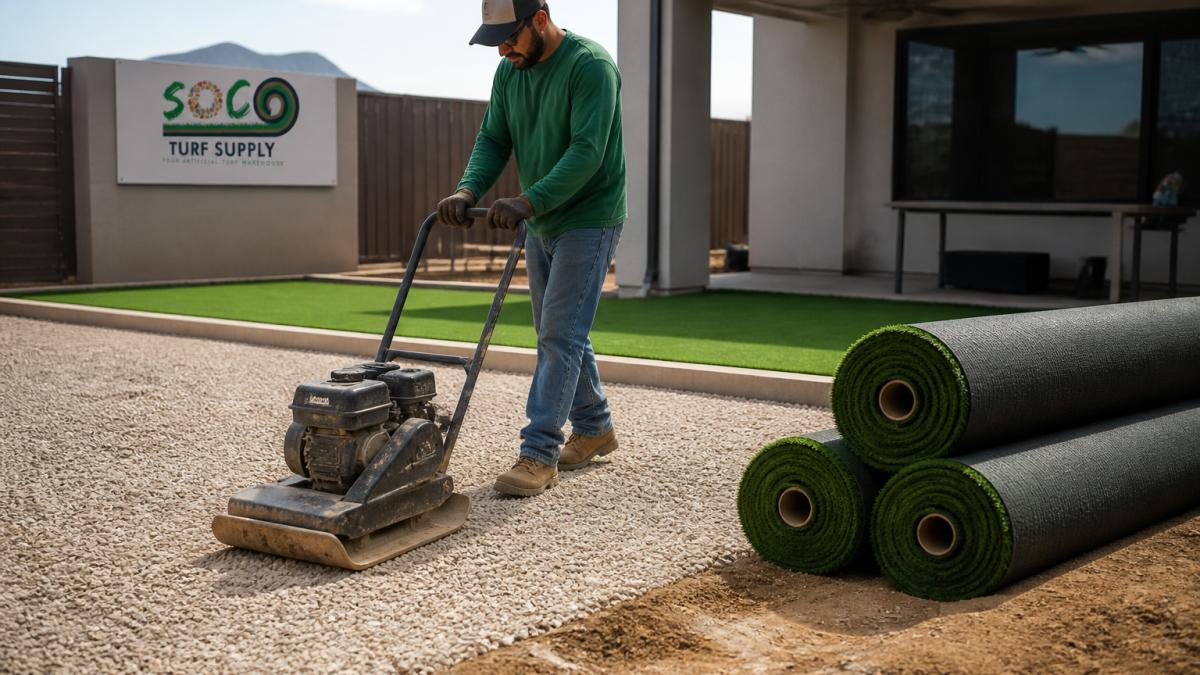
The base is the foundation, and it is where most budgets should go. Crushed stone, typically #57 or a similar angular aggregate, gives you drainage and compaction strength. Decomposed granite packs tighter and suits areas where you want a firmer feel. Paver base panels offer a lightweight alternative for small jobs where excavation is limited. Whatever you choose, the base needs to be angular, not rounded, so the particles lock together under compaction.
Turf, Infill, and Seaming Supplies
Above the base sits the turf roll itself, joined at the edges with seam tape and adhesive and finished with infill. Infill weighs the turf down, holds the blades upright, and helps the surface feel natural underfoot. Seam tape and adhesive are not optional extras; a seam that lifts after a hot summer ruins an otherwise clean install. Order seam tape to match every cut edge and keep a spare roll on hand.
Tools and Equipment
For larger jobs, renting specialized equipment is an option. We’ll cover rentals further down.
Choosing the Right Artificial Grass Base Material
The right artificial grass base material is angular crushed stone compacted to a consistent depth, because it drains well and holds its shape under foot traffic. Decomposed granite and paver base panels are the two main alternatives, and each fits a different situation.
Crushed Stone vs. Decomposed Granite
Crushed stone drains faster and compacts into a stable, open matrix. Decomposed granite packs denser and gives a firmer feel but moves water more slowly. For pet areas and anything with heavy irrigation runoff, crushed stone is the safer pick. For decorative borders and low-traffic zones, decomposed granite works well.
How Much Base Material You Need
Base depth drives your material quantity. A typical residential installation uses a compacted base several inches deep, and the exact figure depends on your subgrade and use case. Measure your square footage, multiply by the target depth, then add extra for compaction loss. Order a little more than the math suggests; running short mid-install stalls the whole job.
Artificial Turf Infill Types and How to Choose
The main artificial turf infill types are silica sand, crumb rubber, and cool-fill products. Silica sand is the standard choice for ballast and blade support. Crumb rubber adds cushioning for play areas. Cool-fill infills are formulated to reduce surface heat, which matters in a climate like the Permian Basin.
If drainage is your priority, it’s worth reading our guidance on the best turf infill for drainage before you commit to a product.
Silica Sand, Crumb Rubber, and Cool-Fill Options
Silica sand is the workhorse: inexpensive, effective, and easy to spread. Crumb rubber gives more bounce and shock absorption, which suits play areas and pet runs. Cool-fill options cost more but keep the surface cooler under direct sun. Match the infill to how the space gets used, not to what’s cheapest per bag.
Artificial Grass Seam Tape and Adhesive: Getting Seams Right
Artificial grass seam tape and adhesive are what hold two turf rolls together as one continuous surface. The tape bridges the gap underneath, and the adhesive bonds both edges to it. A seam done right disappears into the pile. A seam done wrong shows a visible line and starts lifting within a season.
Weed Barrier and Drainage Materials
Weed barrier fabric goes between the base and the turf to stop growth pushing up through the pile. Drainage materials, including open-graded aggregate and perforated pipe where needed, move water away from the surface so it doesn’t pool. In heavy rain, a surface without a drainage path becomes a mud pit under the turf.
For a full walkthrough, see our guide to artificial grass drainage system installation.
Tools and Equipment Rentals for Installation
Specialized installation equipment is expensive to buy and used for a few days per project. Renting a plate compactor, power broom, or turf cutter keeps your capital free and gets professional results. If you’d rather rent than buy, you can rent professional turf installation equipment from us and pick it up alongside your materials.
Common Mistakes When Buying Artificial Turf Materials
Another common error: buying rounded aggregate instead of angular stone. Rounded stone never locks together, so the base shifts under foot traffic and the turf develops ripples. A third is underestimating compaction loss; the base compacts down, so you need more material than the raw volume suggests. Buy from a supplier who stocks the full system, so a missing component doesn’t stall your job.
Get Your Artificial Turf Materials Quote from Soco Turf Supply
Soco Turf Supply offers UV-tested, performance-rated turf blends, professional installation materials, and equipment rentals with warehouse-direct pricing. Our materials are consistent and dependable.
Our turf blends are UV-tested and performance-rated, and we provide expert guidance on projects.
Ready to price out your project? Get an estimate on the materials you need.
Frequently Asked Questions
What materials do you need to install artificial turf?
You need three groups of materials: a base (angular crushed stone, decomposed granite or paver base panels), the turf itself with seam tape, adhesive and infill, and weed barrier fabric plus drainage aggregate. For tools, a plate compactor, power broom and turf cutter are easier to rent than buy. Soco Turf Supply can supply the turf, base, infill and equipment in one order.
What type of base material is best for artificial turf?
Angular crushed stone, such as #57 aggregate, compacted to a consistent depth. It drains well and the particles lock together under foot traffic. Decomposed granite packs denser and suits decorative borders and low-traffic zones. Avoid rounded aggregate: it never locks together, so the base shifts and the turf ripples.
Do you need a weed barrier under artificial turf?
Yes. Weed barrier fabric goes between the base and the turf to stop growth from pushing up through the pile. Pair it with drainage aggregate, and perforated pipe where needed, so water moves away from the surface instead of pooling under the turf.
What artificial turf infill types work best for pets and kids?
Crumb rubber adds cushioning and bounce, which suits play areas and pet runs. Cool-fill products cost more but keep the surface cooler in direct sun, a real advantage in the Permian Basin heat. Silica sand is the standard, low-cost choice for ballast and blade support. Match the infill to how the space is used, not to the cheapest bag.
How much base material and infill do you need for an artificial turf project?
For base, multiply your square footage by the target depth, then add extra to cover compaction loss. A typical residential base is several inches deep, and the exact depth depends on your subgrade and how the area is used. Infill amounts vary by turf blend, so check the manufacturer’s recommendation or include your square footage when you request an estimate.
What materials are used to join artificial turf seams?
Seam tape and adhesive. The tape bridges the gap underneath two turf rolls, and the adhesive bonds both edges to it. Order seam tape for every cut edge and keep a spare roll on hand. A poorly bonded seam shows a visible line and can start lifting within a season.
The gap between a turf job that lasts and one that fails usually comes down to materials, not labor. If you’re planning an installation in Midland or anywhere across the Permian Basin, Soco Turf Supply can supply the turf, base, infill, and equipment in one order, backed by warehouse-direct pricing and UV-tested, performance-rated products. Get started with Soco Turf Supply and build a surface that holds up season after season.
