Last Updated: November 2, 2026
Quick Summary
Reliable artificial turf suppliers for contractors are judged on what happens after the invoice clears: specs you can verify in writing, stock that ships when promised, materials matched to Permian Basin conditions, and documentation you can hand a client. Ask for tier thresholds, UV test results, and warranty terms in writing before you commit.
- A supplier is reliable when four things hold true: verifiable specs, promised stock, local-matched materials, and client-ready documentation.
- Ask any supplier to put tier thresholds in writing before you quote a job.
- Landed cost is per-roll price plus freight plus any minimum-order shortfall.
- For commercial or heavy-traffic installs, higher face weight and density matter more than pile height.
- Installers commonly break up the caliche layer and build a graded, compacted aggregate base on top.
Table of Contents
- What Separates Reliable Artificial Turf Suppliers for Contractors
- Artificial Turf Wholesalers: Warehouse-Direct Pricing and Bulk Tiers
- How Synthetic Turf Manufacturers Build Turf That Survives Permian Basin Heat
- Artificial Turf Installation Materials That Prevent Drainage and Odor Problems
- Artificial Turf Equipment Rentals and the Supply Chain Behind Them
- Warranties, Documentation, and Performance Verification
- Local Soil, Climate, and Delivery Logistics for Midland Contractors
- Get a Warehouse-Direct Estimate for Your Next Turf Project
- Frequently Asked Questions
What Separates Reliable Artificial Turf Suppliers for Contractors
Contractors don’t lose bids because the turf looks bad on day one. They lose them eighteen months later, when a seam lifts or a pet area starts holding odor. Reliable artificial turf suppliers for contractors are judged on what happens after the invoice clears.
A supplier is reliable when four things hold true: specs you can verify in writing, stock that ships when promised, materials that match Permian Basin conditions, and documentation you can hand a client. Below, we break down each trait and what to ask before you commit to a vendor.
Artificial Turf Wholesalers: Warehouse-Direct Pricing and Bulk Tiers
The wholesale-versus-retail gap comes down to how many hands touch the roll before it reaches your trailer. Buying in volume and passing product through a shorter chain is where wholesale savings typically come from. But “wholesale” is not a single price, it is a set of account terms, and the terms matter as much as the per-roll rate when you are pricing a bid.
Bulk tiers are where contractor pricing actually lives. A common structure looks like this:
| Order Size | Typical Tier | What It Usually Unlocks |
|---|---|---|
| Single roll | Retail | Standard lead time |
| Pallet quantity | Trade | Reduced per-roll rate |
| Multi-pallet / project | Contractor | Priority stock allocation |
| Repeat program | Account | Scheduled deliveries |
How Contractors Actually Qualify for a Wholesale Account
Many suppliers require some form of account application before extending contractor pricing.
Ask any supplier to put tier thresholds in writing before you quote a job. The threshold that matters is not the headline discount, it is the quantity break where the per-roll rate actually drops, because that is the number you build your bid around. A supplier who will not state the break in writing is telling you the discount is negotiable, which means it is not a tier at all.
Landed Cost: Freight, Minimums, and Payment Terms
Per-roll price is only part of the number. Landed cost is per-roll price plus freight plus any minimum-order shortfall, and freight is where warehouse-direct buying can quietly lose its edge. A supplier shipping from out of state may quote a lower roll rate and then erase the savings on long-haul freight into West Texas.
Watch out: a low per-roll quote with a high minimum order can leave you buying more turf than the job needs, and leftover rolls are cash sitting in your yard. Confirm the minimum order quantity, whether partial pallets ship, and whether freight is prepaid, collect, or billed back before you compare two suppliers side by side.
Payment terms are the third lever. Payment terms can matter on commercial work with draw schedules.
How Synthetic Turf Manufacturers Build Turf That Survives Permian Basin Heat
Heat is the test that separates real synthetic turf manufacturers from repackagers. UV stabilization in the fiber and backing is what keeps a synthetic lawn from fading or going brittle after a summer of full sun.
Ask for the UV test documentation, not a marketing line. The EPA’s WaterSense program is a useful reference point for clients asking about water savings, since outdoor water use is a major household cost in this region.
Pile Height, Face Weight, and Density: Specs That Decide Durability
Three numbers decide how a turf performs under foot traffic: pile height, face weight, and density. Pile height is the blade length. Face weight is how much fiber sits per square yard. Density is how tightly those fibers are packed.
For commercial or heavy-traffic installs, higher face weight and density matter more than pile height. A tall, thin turf looks lush in the showroom and flattens fast.
Artificial Turf Installation Materials That Prevent Drainage and Odor Problems
Drainage failures almost always trace back to the sub-base and the infill, not the turf itself. A properly compacted base, correct seaming tape, and the right infill material do more for longevity than any single product upgrade.
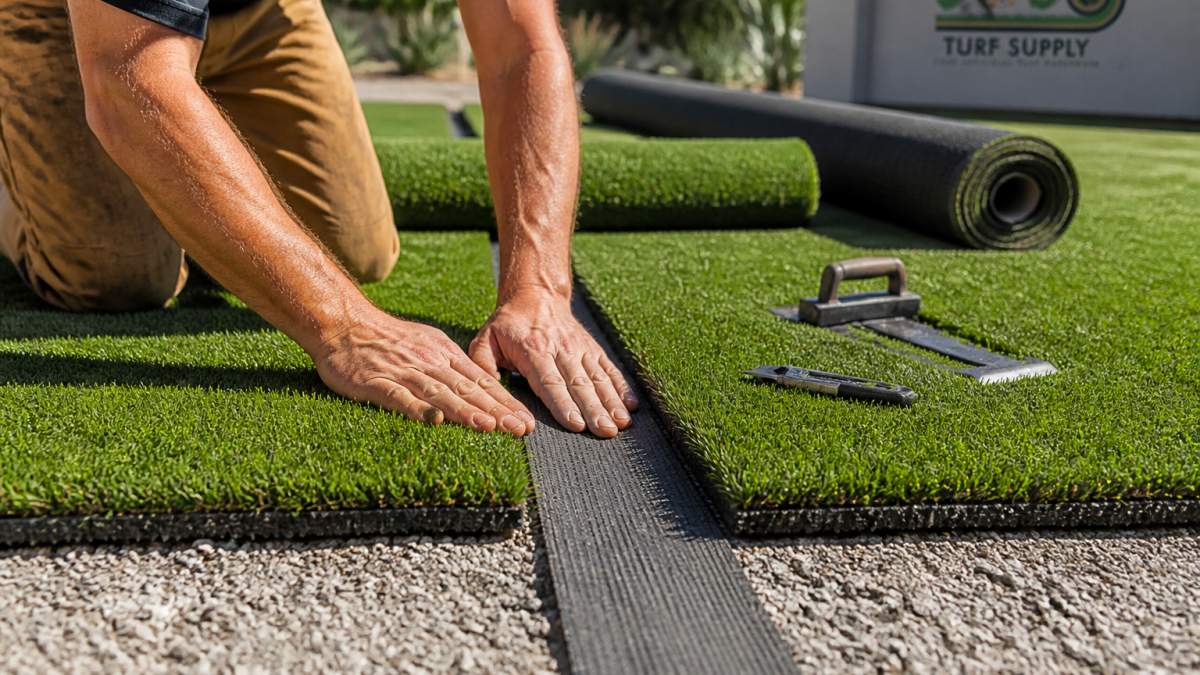
Pet-friendly turf needs an infill that manages moisture and controls odor.
Artificial Turf Equipment Rentals and the Supply Chain Behind Them
Equipment availability is an underrated reliability signal.
Material lead times and freight shipping matter just as much. Ask how far out stock is committed and whether delivery is scheduled or first-come.
Warranties, Documentation, and Performance Verification
A manufacturer warranty is only as good as the paperwork behind it. Reliable suppliers provide UV test results, performance ratings, and warranty terms in writing, before you buy.
Contractors bidding commercial work need this for client presentations. If a supplier can’t produce documentation on request, treat that as your answer. Verify what the warranty actually covers: fading, fiber degradation, and backing failure are often handled differently.
Local Soil, Climate, and Delivery Logistics for Midland Contractors
Caliche-heavy soil and alkaline conditions across the Permian Basin change how sub-base prep should go, and a supplier who knows the local ground can give better guidance.
Why Caliche Changes Sub-Base Prep
Caliche is a calcium-carbonate-cemented layer common across West Texas. It is hard, it does not drain like loose aggregate, and it does not compact the way clean crushed stone does. Installers commonly break up the caliche layer and build a properly graded and compacted aggregate base on top rather than compacting directly over the cemented layer.
Alkaline soil is the second local factor. High-pH ground and hard irrigation water can affect how infill and base materials behave over time, so it is worth asking a supplier whether their recommended infill and stabilization approach has been used on local jobs.
Heat, UV, and the Permian Basin Summer
Midland summers push synthetic turf hard. Sustained heat and intense sun are the real test of UV stabilization, and that is why the fiber and backing documentation covered earlier in this guide matters more locally than it does in milder climates. Surface temperature on any synthetic surface runs hotter than ambient air, so for pet areas and play zones, ask about infill choices that manage heat as well as moisture. The EPA’s WaterSense program remains a useful reference for clients asking about outdoor water savings in an arid region.
Freight and Delivery Into Midland and the Basin
Regional logistics matter as much as product. Freight into Midland and the surrounding basin can have its own timing considerations. Ask three questions before you schedule an install: is the stock already in the region or committed from an out-of-state warehouse, is delivery scheduled or first-come, and can the supplier hit a specific job-site window rather than a multi-day range?
For contractors running multiple sites, predictable delivery matters as much as roll price. If you’re searching for artificial turf suppliers near me, prioritize one that understands both the climate and the delivery route, local stock, local ground knowledge, and a delivery schedule you can build a crew around.
Get a Warehouse-Direct Estimate for Your Next Turf Project
Pricing on artificial turf depends on quantity, project scope, and delivery timing, so the fastest path to real numbers is a direct quote. We offer UV-tested, performance-rated turf blends, installation materials, and equipment rentals, with expert guidance on every project.
Get started with Soco Turf Supply and price your next Midland project with warehouse-direct pricing and documentation you can hand your client. Request an estimate to move forward.
Frequently Asked Questions
What should contractors look for in artificial turf suppliers?
Check four things: UV-tested and performance-rated products with documentation you can show clients, warehouse-direct pricing, installation materials, and delivery capacity for your project size. Ask for product specs in writing, including pile height, face weight, and drainage rate. A supplier that answers these questions quickly and consistently is the one to keep.
Where can contractors buy artificial turf in Midland, TX?
Contractors working in the Permian Basin can buy from a local storefront supplier that stocks turf, installation materials, and equipment for pickup or delivery. Ask whether the supplier stocks enough inventory for your project and what delivery options are available.
How can contractors compare artificial turf products for different projects?
Match specs to use. For pet areas, prioritize perforated backing and drainage rate. For commercial sites with heavy foot traffic, look at face weight and turf density. For West Texas heat, confirm UV stabilization and heat-resistant technology. Compare pile height and infill material across products before you commit to a bulk order.
What supplies and equipment should an artificial turf supplier offer?
A full-service supplier should carry artificial turf installation materials, plus equipment rentals. Confirm rental availability and pickup or delivery options before scheduling installation.
